MCQ
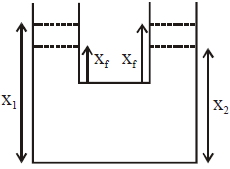
Two identical cylindrical vessels are kept on the ground and each contain the same liquid of density $d.$ The area of the base of both vessels is $S$ but the height of liquid in one vessel is $x_{1}$ and in the other, $x_{2}$. When both cylinders are connected through a pipe of negligible volume very close to the bottom, the liquid flows from one vessel to the other until it comes to equilibrium at a new height. The change in energy of the system in the process is
  • A
    ${gdS}\left(x_{2}+x_{1}\right)^{2}$
  • B
    $\frac{3}{4} g d S\left(x_{2}-x_{1}\right)^{2}$
  • $\frac{1}{4} g d S\left(x_{2}-x_{1}\right)^{2}$
  • D
    ${gdS}\left(x_{2}^{2}+x_{1}^{2}\right)$
Answer

Correct option: C.
$\frac{1}{4} g d S\left(x_{2}-x_{1}\right)^{2}$
c
$U _{ i }=\left(\rho Sx _{1}\right) g \cdot \frac{ x _{1}}{2}+\left(\rho Sx _{2}\right) g \cdot \frac{ x _{2}}{2}$

$U _{ f }=\left(\rho Sx _{ f }\right) g \cdot \frac{ x _{ f }}{2} \times 2$

By volume conservation

$Sx _{1}+ Sx _{2}= S \left(2 x _{ f }\right)$

$x_{f}=\frac{x_{1}+x_{2}}{2}$

$\Delta U =\rho \operatorname{Sg}\left[\left(\frac{ x _{1}^{2}}{2}+\frac{ x _{2}^{2}}{2}\right)- x _{ f }^{2}\right]$

$=\rho \operatorname{Sg}\left[\frac{ x _{1}^{2}}{2}+\frac{ x _{2}^{2}}{2}-\left(\frac{ x _{1}+ x _{2}}{2}\right)^{2}\right]$

$=\frac{\rho Sg }{2}\left[\frac{ x _{1}^{2}}{2}+\frac{ x _{2}^{2}}{2}- x _{1} x _{2}\right]$

$=\frac{\rho Sg }{4}\left( x _{1}- x _{2}\right)^{2}$

Need a full question paper?

Generate a complete, print-ready paper with questions like this in minutes — across 16+ boards, with answer keys.

Start Generating Free

Similar questions

At constant pressure how much fraction of heat supplied to gas is converted into mechanical work?
A wire of length $L$ and radius $r$ is clamped rigidly at one end. When the other end of the wire is pulled by a force $f$, its length increases by $l$. Another wire of same material of length $2 L$ and radius $2 r$ is pulled by a force $2 f$. Then the increase in its length will be
(i) What is the work done by the porter when he climbs up a height of 10m (g = 10 ms−2)?
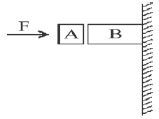
Given in the figure are two blocks $A$ and $B$ of weight $20\ N$ and $100\ N,$ respectively. These are being pressed against a wall by a force $F$ as shown. If the coefficient of friction between the blocks is $0.1$ and between block $B$ and the wall is $0.15$, the frictional force applied by the wall on block $B$ is ........... $N$
A particle starts from rest and performing circular motion of constant radius with speed given by $v = \alpha \sqrt x$ where $\alpha$ is a constant and $x$ is the distance covered. The correct graph of magnitude of its tangential acceleration $(a_t)$ and centripetal acceleration $(a_c)$ versus $t$ will be:
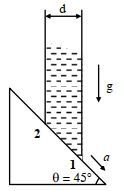
A cylindrical tube, with its base as shown in the figure, is filled with water. It is moving down with a constant acceleration $a$ along a fixed inclined plane with angle $\theta=45^{\circ} . P_1$ and $P_2$ are pressures at points 1 and 2 , respectively, located at the base of the tube. Let $\beta=\left(P_1-P_2\right) /(\rho g d)$, where $\rho$ is density of water, $d$ is the inner diameter of the tube and $g$ is the acceleration due to gravity. Which of the following statement($s$) is(are) correct?

$(A)$ $\beta=0$ when $a= g / \sqrt{2}$

$(B)$ $\beta>0$ when $a= g / \sqrt{2}$

$(C)$ $\beta=\frac{\sqrt{2}-1}{\sqrt{2}}$ when $a= g / 2$

$(D)$ $\beta=\frac{1}{\sqrt{2}}$ when $a= g / 2$

A road is banked at an angle of $30^o$ to the horizontal for negotiating a curve of radius $10\sqrt 3 m$. At what velocity will a car experience no friction while negotiating the curve? ............... $km/hr$
Two identical thin uniform rods of mass $M$ and length $L$ are placed in a line at separation of $L$ . Find the gravitational force acting between them
A liquid in a beaker has temperature $\theta (t)$ at time $t$ and $\theta_0$ is temperature of surroundings, then according to Newton's law of cooling the correct graph between loge $log_e(\theta - \theta_0) $ and $t$ is
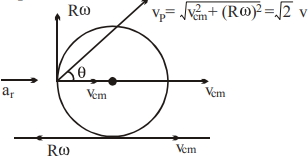
$A$ disc of radius $R$ is rolling purely on a flat horizontal surface, with a constant angular velocity. The angle between the velocity and acceleration vectors of point $P$ is