MCQ
Two identical cylindrical vessels with their bases at same level, each contains a liquid of density $d$ . The height of the liquid in one vessel is $ h_1$ and that in the other vessel is $h_2$ . The area of either base is $A$ . The work done by gravity in equalizing the levels when the two vessels are connected is
  • A
    $(h_1 -h_2)gd$
  • B
    $(h_1 -h_2)gAd$
  • C
    $\frac {1}{2}(h_1 -h_2)^2gAd$
  • $\frac {1}{4}(h_1 -h_2)^2gAd$

Answer

Correct option: D.
$\frac {1}{4}(h_1 -h_2)^2gAd$
d
Work done = initial potential energy -final potential energy 

or $W{\text{ }} = {\text{ }}Adg\,\left[ {\frac{{h_1^2 + h_2^2}}{2} - {{\left( {\frac{{{h_1} + {h_2}}}{2}} \right)}^2}} \right]\, = \,\frac{{Adg}}{4}{({h_1} - {h_2})^2}$

Need a full question paper?

Generate a complete, print-ready paper with questions like this in minutes — across 16+ boards, with answer keys.

Start Generating Free

Similar questions

At what temperature will the oxygen molecules have the same root mean square speed as hydrogen molecules at $200 \,K$ ....... $K$
Coatings used on raincoat are waterproof because
The ratio of the velocity of sound in hydrogen gas $(\gamma = 7/5)$ to that in helium gas $(\gamma = 5/3)$ at the same temperature will be
Unit of power is
Which of the following options are correct?
  1. Acceleration due to gravity decreases with increasing altitude.
  2. Acceleration due to gravity increases with increasing depth $($assume the earth to be a sphere of uniform density$).$
  3. Acceleration due to gravity increases with increasing latitude.
  4. Acceleration due to gravity is independent of the mass of the earth.
In thermodynamic processes which of the following statements is not true?
An ideal gas is expanding such that $\mathrm{PT}^2=$ constant. The coefficient of volume expansion of the gas is
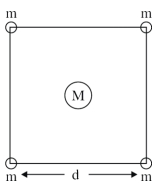
Four spheres each of mass $m$ form a square of side $d$ (as shown in figure). A fifth sphere of mass $M$ is situated at the centre of square. The total gravitational potential energy of the system is
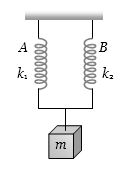
A mass $m$ is suspended by means of two coiled spring which have the same length in unstretched condition as in figure. Their force constant are $k_1$ and $k_2$ respectively. When set into vertical vibrations, the period will be
A force of $6.4\, N$ stretches a vertical spring by $0.1 \,m$. The mass that must be suspended from the spring so that it oscillates with a period of $\left( {\frac{\pi }{4}} \right)sec$. is  ... $kg$