MCQ
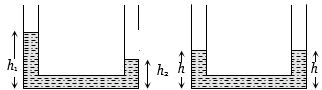
Two identical cylindrical vessels with their bases at same level each contains a liquid of density $\rho$. The height of the liquid in one vessel is ${h_1}$ and that in the other vessel is ${h_2}$. The area of either base is $A$. The work done by gravity in equalizing the levels when the two vessels are connected, is
  • A
    $({h_1} - {h_2})g\rho $
  • B
    $({h_1} - {h_2})gA\rho $
  • C
    $\frac{1}{2}{({h_1} - {h_2})^2}gA\rho $
  • $\frac{1}{4}{({h_1} - {h_2})^2}gA\rho $

Answer

Correct option: D.
$\frac{1}{4}{({h_1} - {h_2})^2}gA\rho $
d
(d)If $h$ is the common height when they are connected, by conservation of mass

$\rho A_{1} h_{1}+\rho A_{2} h_{2}=\rho h\left(A_{1}+A_{2}\right)$

$h=\left(h_{1}+h_{2}\right) / 2\;\;\;\left[\right.$ as $A_{1}=A_{2}=A$ given $]$

As $\left(h_{1} / 2\right)$ and $\left(h_{2} / 2\right)$ are heights of initial centre of gravity of liquid in two vessels., the initial potential energy of the system $U_{i}=\left(h_{1} A \rho\right) g \frac{h_{1}}{2}+\left(h_{2} A \rho\right) \frac{h_{2}}{2}=\rho g A \frac{\left(h_{1}^{2}+h_{2}^{2}\right)}{2} \ldots( i )$

When vessels are connected the height of centre of gravity of liquid in each vessel will be $h / 2$, i.e. $\left(\frac{\left(h_{1}+h_{2}\right)}{4}\right.$ [as $\left.h=\left(h_{1}+h_{2}\right) / 2\right]$

Final potential energy of the system

$U_{F}=\left[\frac{\left(h_{1}+h_{2}\right)}{2} A \rho\right] g\left(\frac{h_{1}+h_{2}}{4}\right)$

$=A \rho g\left[\frac{\left(h_{1}+h_{2}\right)^{2}}{4}\right] \ldots$.(ii)

Work done by gravity $W=U_{i}-U_{f}=\frac{1}{4} \rho g A\left[2\left(h_{1}^{2}+h_{2}^{2}\right)-\left(h_{1}+h_{2}\right)^{2}\right]$

$=\frac{1}{4} \rho g A\left(h_{1}-h_{2}\right)^{2}$
Need a full question paper?

Generate a complete, print-ready paper with questions like this in minutes — across 16+ boards, with answer keys.

Start Generating Free

Similar questions

$Assertion :$ Smaller drops of liquid resist deforming forces better than the larger drops
$Reason :$ Excess pressure inside a drop is directly proportional to its surface area.
Two identical piano wires, kept under the same tension $T$ have a fundamental frequency of $600\,\, Hz.$ The fractional increase in the tension of one of the wires which will lead to occurrence of $6\,\, beats/s$ when both the wires oscillate together would be
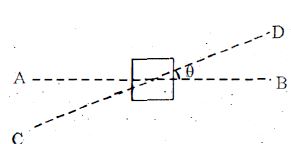
Let $I$ be the moment of inetia of a uniform square plate about an axis $AB$ that passes though its centre and is parallel to two of its sides. $CD$ is a line in the plane of the plate that passes through the centre of the plate and makes an angle $\theta $ with $AB$ . The moment of inertia of the plate about the axis $CD$ is then equal to
Two identical adiabatic vessels are filled with oxygen at pressure $P_1$ and $P_2 (P_1 > P_2).$ The vessels are interconnected with each other by a nonconducting pipe. If $U_{01}$ and $U_{02}$ denote initial internal energy of oxygen in first and second vessel respectively and $U_{f_1}$ and  $U_{f_2}$ denote final internal energy values, than :
Air is pushed into a soap, bubble of radius r to double its radius. If the surface tension of the soap solution is S, the work done in the process is:
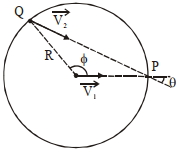
Two particles, one at the centre of a circle of radius $R$, and another at a point $Q$ on the circle, start moving towards a point $P$ on the circle at the same time (see figure below). Both are at rest initially and move with uniform velocities $\vec{V}_1$ and $\overrightarrow{V_2}$ respectively. They also reach the point $P$ at the same time, If the angle between the velocities is $\theta$ and the angle subtended by $P$ and $Q$ at the centre is $\phi$ (as shown in the figure), then
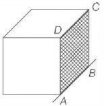
A solid cube of wood of side $2 a$ and mass $M$ is resting on a horizontal surface as shown in the figure below. The cube is free to rotate about a fixed axis $A B . A$ bullet of mass $m( < < M)$ and speed $v$ is shot horizontally at the face opposite to $A B C D$ at a height of $4 a / 3$ from the surface to impart the cube an angular speed $\omega$. It strikes the face embeds in the cube. Then, $\omega$ is close to (Note : The moment of inertia of the cube about an axis perpendicular to the face and passing through the centre of mass is $\left.2 M a^2 / 3\right)$
A force $\mathrm{F}=20+10 \mathrm{y}$ acts on a particle in $y$ direction where $\mathrm{F}$ is in newton and $\mathrm{y}$ in meter. Work done by this force to move the particle from $y=0$ to $y=1 \;\mathrm{m}$ is......$J$
Two waves are approaching each other with a velocity of $20 m/s$ and frequency $n$. The distance between two consecutive nodes is
Oxygen is $16$ times heavier than hydrogen. Equal volumes of hydrogen and oxygen are mixed. The ratio of speed of sound in the mixture to that in hydrogen is