MCQ
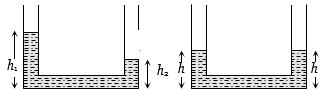
Two identical cylindrical vessels with their bases at same level each contains a liquid of density $\rho$. The height of the liquid in one vessel is ${h_1}$ and that in the other vessel is ${h_2}$. The area of either base is $A$. The work done by gravity in equalizing the levels when the two vessels are connected, is
  • A
    $({h_1} - {h_2})g\rho $
  • B
    $({h_1} - {h_2})gA\rho $
  • C
    $\frac{1}{2}{({h_1} - {h_2})^2}gA\rho $
  • $\frac{1}{4}{({h_1} - {h_2})^2}gA\rho $

Answer

Correct option: D.
$\frac{1}{4}{({h_1} - {h_2})^2}gA\rho $
d
(d)If $h$ is the common height when they are connected, by conservation of mass

$\rho A_{1} h_{1}+\rho A_{2} h_{2}=\rho h\left(A_{1}+A_{2}\right)$

$h=\left(h_{1}+h_{2}\right) / 2\;\;\;\left[\right.$ as $A_{1}=A_{2}=A$ given $]$

As $\left(h_{1} / 2\right)$ and $\left(h_{2} / 2\right)$ are heights of initial centre of gravity of liquid in two vessels., the initial potential energy of the system $U_{i}=\left(h_{1} A \rho\right) g \frac{h_{1}}{2}+\left(h_{2} A \rho\right) \frac{h_{2}}{2}=\rho g A \frac{\left(h_{1}^{2}+h_{2}^{2}\right)}{2} \ldots( i )$

When vessels are connected the height of centre of gravity of liquid in each vessel will be $h / 2$, i.e. $\left(\frac{\left(h_{1}+h_{2}\right)}{4}\right.$ [as $\left.h=\left(h_{1}+h_{2}\right) / 2\right]$

Final potential energy of the system

$U_{F}=\left[\frac{\left(h_{1}+h_{2}\right)}{2} A \rho\right] g\left(\frac{h_{1}+h_{2}}{4}\right)$

$=A \rho g\left[\frac{\left(h_{1}+h_{2}\right)^{2}}{4}\right] \ldots$.(ii)

Work done by gravity $W=U_{i}-U_{f}=\frac{1}{4} \rho g A\left[2\left(h_{1}^{2}+h_{2}^{2}\right)-\left(h_{1}+h_{2}\right)^{2}\right]$

$=\frac{1}{4} \rho g A\left(h_{1}-h_{2}\right)^{2}$
Need a full question paper?

Generate a complete, print-ready paper with questions like this in minutes — across 16+ boards, with answer keys.

Start Generating Free

Similar questions

The length of a rod is $20\, cm$ and area of cross-section $2\,c{m^2}$. The Young's modulus of the material of wire is $1.4 \times {10^{11}}\,N/{m^2}$. If the rod is compressed by $5\, kg-wt$ along its length, then increase in the energy of the rod in joules will be
If momentum is increased by $20\%$ , then K.E. increases by ........... $\%$
A constant current i is maintained in a solenoid. Which of the following quantities will increase if an iron rod is inserted in the soleniod along axis?
  1. Magnetic field at the centre.
  2. Mangetic flux linked with the solenoid.
  3. Self-inductance of the solenoid.
  4. Rate of Joule heating.
Two tubes of radii $r_1$ and $r_2$, and lengths $l_1$ and $l_2$, respectively, are connected in series and a liquid flows through each of them in streamline conditions. $P_1$ and $P_2$ are pressure differences across the two tubes. If $P_2$ is $4P_1$ and $l_2$ is $ \frac{l_1}{4}$ , then the radius $r_2$ will be equal to
A particle of mass $m$ moves on the x-axis as follows : it starts from rest at $t = 0$ from the point $x = 0$ and comes to rest at $ t= 1$ at the point $x = 1$. No other information is available about its motion at intermediate time $(0 < t < 1)$. If $\alpha $ denotes the instantaneous acceleration of the particle, then
A bullet is dropped from the same height when another bullet is fired horizontally. They will hit the ground
One mole of ideal gas goes through process $P= 2V^2/(1+V^2)\,Pa$ then change in temperature of gas when volume changes from $V= 1\,m^3$ to $2\,m^3$ is
A car travels $6\, km$ towards north at an angle of $45^o$ to the east and then travels distance of $4\, km$ towards north at an angle $135^o$ to east. How far is the point from the starting point? What angle does the straight line joining its initial and final position makes with the east?
A wire of length $2\,L$ is made by joining two wires $A$ and $B$ of same lengths but different radii $r$ and $2r$ and made of the same material. It is vibrating at a frequency such that the joint of the two wires forms a node. If the number of antinodes in wire $A$ is $p$ and that in $B$ is $q$ then the ratio $p : q$ is
If the percentage errors in measuring the length and the diameter of a wire are $0.1 \%$ each. The percentage error in measuring its resistance will be: