MCQ
Two identical fuses are rated at $10\,A$. If they are joined
  • A
    in parallel, the combination acts as a fuse of rating $20\,A$
  • B
    in parallel, the combination acts as a fuse of rating $5\,A$
  • C
    in series, the combination acts as a fuse of rating $10\,A.$
  • Both $(A)$ and $(C)$

Answer

Correct option: D.
Both $(A)$ and $(C)$
d
A fuse is a piece of wire resistance which acts in a way such that if the voltage in a circuit exceeds the rating of the fuse then the fuse wire melts and the circuit becomes an open circuit, thereby breaking the circuit and preventing the components from getting damaged due to short circuit. Now, if two fuses are in series, the melting of a single fuse can break the circuit and so in series the rating will be $10 \mathrm{A}$. However, in parallel, even if one fuse is melted, the other fuse still works and so the net rating will be $20 \mathrm{A}$.

Need a full question paper?

Generate a complete, print-ready paper with questions like this in minutes — across 16+ boards, with answer keys.

Start Generating Free

Similar questions

One mole of a monoatomic gas is mixed with three moles of a diatomic gas. The molecular specific heat of mixture at constant volume is $\frac{\alpha^{2}}{4} R J / mol\,K$; then the value of $\alpha$ will be $.......$ (Assume that the given diatomic gas has no vibrational mode.)
A ball is dropped from the roof of a tower of height $h$. The total distance covered by it in the last second of its motion is equal to the distance covered by it in first three seconds. The value of $h$ in meter is  $(g = 10\,m/s^2)$
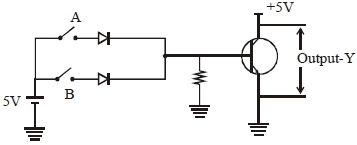
Boolean relation at the output stage$-Y$ for the following circuit is
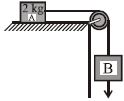
The coefficient of static friction, $\mu _s$ between block $A$ of mass $2\,kg$ and the table as shown in the figure is $0.2$. What would be the maximum mass value of block $B$ so that the two blocks $B$ so that the two blocks do not move? The string and the pulley are assumed to be smooth and masseless ....... $kg$ $(g = 10\,m/s^2)$
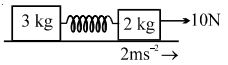
Find the acceleration of $3 kg$ mass when acceleration of $2 kg$ mass is $2 ms^{^{-2}}$ as shown in figure. ......... $ms^{-2}$
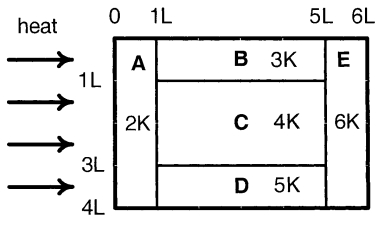
A composite block is made of slabs $A, B, C, D$ and $E$ of different thermal conductivities (given in terms of a constant $K$ ) and sizes (given in terms of length, $L$ ) as shown in the figure. All slabs are of same width. Heat $'Q'$ flows only from left to right through the blocks. Then in steady state $Image$

$(A)$ heat flow through $A$ and $E$ slabs are same.

$(B)$ heat flow through slab $E$ is maximum.

$(C)$ temperature difference across slab $E$ is smallest.

$(D)$ heat flow through $C =$ heat flow through $B +$ heat flow through $D$.

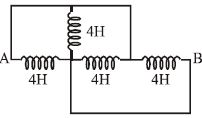
The equivalent inductance between $\mathrm{A}$ and $\mathrm{B}$ is.....$H$
For a particle showing motion under the force $F=-5(x-2)$, the motion is ...........
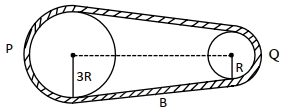
In the given figure, two wheels $P$ and $Q$ are connected by a belt $B$. The radius of $P$ is three times as that of $Q$. In case of same rotational kinetic energy, the ratio of rotational inertias $\left(\frac{{I}_{1}}{{I}_{2}}\right)$ will be ${x}: 1$. The value of ${x}$ will be $.....\, .$
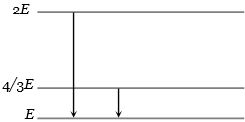
The following diagram indicates the energy levels of a certain atom when the system moves from 2E level to E, a photon of wavelength $\lambda $ is emitted. The wavelength of photon produced during its transition from $\frac{{4E}}{3}$ level to E is