MCQ
Two identical stringed instruments have frequency $100 Hz$. If tension in one of them is increased by $4\%$ and they are sounded together then the number of beats in one second is
  • A
    $1$
  • B
    $8$
  • C
    $4$
  • $2$

Answer

Correct option: D.
$2$
d
(d) Frequency of vibration in tight string
$n = \frac{p}{{2l}}\sqrt {\frac{T}{m}} $

$\Rightarrow n \propto \sqrt T $

==>$\frac{{\Delta n}}{n} = \frac{{\Delta T}}{{2T}} = \frac{1}{2} \times (4\% ) = 2\% $

==> Number of beats = $\Delta n = \frac{2}{{100}} \times n = \frac{2}{{100}} \times 100 = 2$

Need a full question paper?

Generate a complete, print-ready paper with questions like this in minutes — across 16+ boards, with answer keys.
Start Generating Free

Similar questions

A neutron exerts a force on a proton which is:
  1. Gravitational.
  2. Electromagnetic.
  3. Nuclear.
  4. Weak.
A sample of an ideal gas undergoes an isothermal expansion. If $d Q, d U$ and $d W$ represent the amount of heat supplied, the change in internal energy and the work done respectively, then
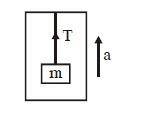
A block of mass $m$ is suspended by a light thread from an elevator. The elevator is accelerating upward with uniform acceleration $a$ . The work done by tension on the block during $t$ seconds is $(u = 0)$
Two waves are represented by the equations : $y_1 = a\, sin\,(\omega t + kx + 0.57)\, m$ and $y_2 = a\, cos\,(\omega t + kx)\, m$, where $x$ is in $metres$ and $t$ is in $seconds$ . The phase difference between them is ..... $radian$
The maximum horizontal range of a projectile is $16\,km$ when the projectile is thrown at an elevation of $30^o$ from the horizontal, it will reach to the maximum height of ....... $km$
A ball is thrown up, it reaches a maximum height and then comes down. If $t_1(t_2 > t_1)$ are the times that the ball takes to be at a particular height then the time taken by the ball to reach the highest point is:
Two projectiles $A$ and $B$ are thrown with the same speed but angles are $40^{\circ}$ and $50^{\circ}$ with the horizontal. Then
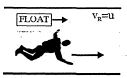
A swimmer can swim with speed '$v$' with respect to still water in a river which is flowing with speed $u$. There is a float moving with the river. Now the swimmer overtakes float and gets a lead of $l$ and returns back to the float. Time taken by swimmer in this process will be
Two large, identical water tanks, $1$ and $2$ , kept on the top of a building of height $H$, are filled with water up to height $h$ in each tank. Both the tanks contain an identical hole of small radius on their sides, close to their bottom. A pipe of the same internal radius as that of the hole is connected to tank $2$ , and the pipe ends at the ground level. When the water flows the tanks $1$ and $2$ through the holes, the times taken to empty the tanks are $t_1$ and $t_2$, respectively. If $H=\left(\frac{16}{9}\right) h$, then the ratio $t_1 / t_2$ is. . . . .
The rate of doing work by force acting on a particle moving along $x$-axis depends on position $x$ of particle and is equal to $2 x$. The velocity of particle is given by expression