MCQ
Two incident monochromatic waves whose wavelengths differ by a small amount $d\lambda$ are separated angularly at $\theta$ and $\theta + d\theta$ $w.r.t$. the incidence ray. The dispersive power is given by
  • A
    $d\theta /\theta$
  • $d\theta /d\lambda$
  • C
    $d\lambda /\lambda$
  • D
    $\lambda (d\lambda /d\theta )$

Answer

Correct option: B.
$d\theta /d\lambda$
b
Angular dispersion $=\theta+d \theta-\theta$ $=d \theta$

deviation in mean ray $= d \lambda$

Dispersive power, $\omega=\frac{\text { Angular digpersion }}{\text { Deviation in mean ray }}$ $=\frac{ d \theta}{ d \lambda}$

Need a full question paper?

Generate a complete, print-ready paper with questions like this in minutes — across 16+ boards, with answer keys.

Start Generating Free

Similar questions

Masses of $3$ wires of same metal are in the ratio $1 : 2 : 3$ and their lengths are in the ratio $3 : 2 : 1$. The electrical resistances are in ratio
The size of corpuscles are $........$ for different colours.
A cylindrical copper rod has length $L$ and resistance $R$. If it is melted and formed into another rod of length $2 L$, then the resistance will be ....... $R$
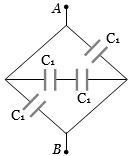
Four identical capacitors are connected as shown in diagram. When a battery of $6 V$ is connected between $A$ and $B$, the charge stored is found to be $1.5\, \mu C$. The value of ${C_1}$ is........$\mu F$
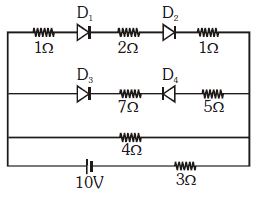
All the diodes are ideal. The current flowing in $2\,\Omega $ resistor connected between the diodes $D_1$ and $D_2$ is.......$A$
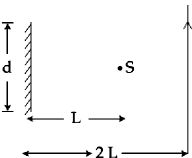
A point source of light, $S$ is placed at a distance $L$ in front of the centre of plane mirror of width $d$ which is hanging vertically on a wall. A man walks in front of the mirror along a line parallel to the mirror, at a distance $2\, L$ as shown below. The distance over which the man can see the image of the light source in the mirror:
If $10\%$ of a radioactive material decays in $5$ days, then the amount of original material left after $20$ days is approximately ...............$\%$
In a radioactive reaction $92^{ X ^{232}} \rightarrow 82^{ Y ^{204}}$ , the number of α - particles emitted is
Assertion : A proton and an alpha particle having the same kinetic energy are moving in circular paths in a uniform magnetic field. The radii of their circular paths will be equal.

Reason : Any two charged particles having equal kinetic energies and entering a region of uniform magnetic field $\overrightarrow B $ in a direction perpendicular to $\overrightarrow B $, will describe circular trajectories of equal radii.

The characteristic impedance of a coaxial cable is of the order of