MCQ
Two independent parallel wires in which the current is flowing in the same direction. They will:
  • attract each other
  • B
    repel each other
  • C
    not exert any force on each other
  • D
    current in one of the wire vanishes

Answer

Correct option: A.
attract each other

Need a full question paper?

Generate a complete, print-ready paper with questions like this in minutes — across 16+ boards, with answer keys.
Start Generating Free

Similar questions

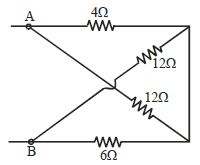
In given Network the equivalent resistance between $A$ and $B$ is .............. $\Omega$
Two equal positive point charges are kept at points $A$ and $B$ . The electric potential, while moving from $A$ to $B$ along straight line
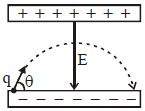
A proton is fired at an initial velocity of $150 \,m/s$ at an angle of $60^o $ above the horizontal into a uniform electric field of $2 \times 10^{-4} \,N/C$ between two charged parallel plates as shown in figure. Then the total time the particle is in motion is :-
A steady current $I$ is set up in a wire whose cross-sectional area decreases in the direction of the flow of the current. Then, as we examine the narrowing region,
The charge flowing through a resistance $R$ varies with time $t$ as $ Q=at-bt^2 $ where $a$ and $b$ are positive constants . The total heat produced in $R$ is
A $p-n$ photodiode is manufactured from a semiconductor with band gap of $3.1 \,eV$. Which of the following wavelengths can be detected by it?
A parallel plate capacitor is charged and the charging battery is then disconnected. If the plates of the capacitor are moved further apart by means of insulating handles, then
In a transistor amplifier, $\beta = 62, R_L = 5000\, \Omega$ and internal resistance of the  transistor is $500\, \Omega$. The voltage amplification of the amplifier will be:
Select the correct statements from the following
At time $t=0$ some radioactive gas is injected into a sealed vessel. At time $T$ some more of the gas is injected into the vessel. Which one of the following graphs best represents the logarithm of the activity $A$ of the gas with time $t$ ?