MCQ
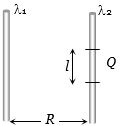
Two infinitely long parallel wires having linear charge densities ${\lambda _1}$ and ${\lambda _2}$ respectively are placed at a distance of $R$ metres. The force per unit length on either wire will be $\left( {K = \frac{1}{{4\pi {\varepsilon _0}}}} \right)$
  • A
    $K\frac{{2{\lambda _1}{\lambda _2}}}{{{R^2}}}$
  • $K\frac{{2{\lambda _1}{\lambda _2}}}{R}$
  • C
    $K\frac{{{\lambda _1}{\lambda _2}}}{{{R^2}}}$
  • D
    $K\frac{{{\lambda _1}{\lambda _2}}}{R}$
Answer

Correct option: B.
$K\frac{{2{\lambda _1}{\lambda _2}}}{R}$
b
(b) Force on $l$ length of the wire $2$ is
${F_2} = Q{E_1} = ({\lambda _2}l)\frac{{2k{\lambda _1}}}{R}$
$==>$ $\frac{{{F_2}}}{l} = \frac{{2k{\lambda _1}{\lambda _2}}}{R}$
Also $\frac{{{F_1}}}{l} = \frac{{{F_2}}}{l} = \frac{F}{l} = \frac{{2k{\lambda _1}{\lambda _2}}}{R}$

Need a full question paper?

Generate a complete, print-ready paper with questions like this in minutes — across 16+ boards, with answer keys.

Start Generating Free

Similar questions

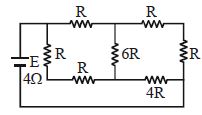
A battery of internal resistance $4\, ohm$ is connected to the network of resistance as hown.  In the order that the maximum power can be delivered to the network, the value of $R$ in ohm should be :-
A capacitor with capacitance $5\,\mu F$ is charged to $5\,\mu C.$ If the plates are pulled apart to reduce the capacitance to $2\,\mu F,$ how much work is done?
A small square loop of wire of side $l$ is placed inside a large square loop of wire of side $L(L >> l)$. The loops are coplaner and their centres coincide. The mutual inductance of the system is propotional to
When $100\, V\, DC$ is applied across a solenoid a current of $1\, A$ flows in it. When $100\, V\, AC$ is applied across the same coil, the current drops to $0.5\, A$. If the frequency of the $AC$ source is $50\,Hz$, the impedance and inductance of the solenoid are:
Two particles $A$ and $B$ of equal masses are suspended from two massless springs of spring constants $K _{1}$ and $K _{2}$ respectively.If the maximum velocities during oscillations are equal, the ratio of the amplitude of $A$ and $B$ is
Blood velocity: The flow of blood in a large artery of an anesthetised dog is diverted through a Venturi meter. The wider part of the meter has a crosssectional area equal to that of the artery. $A = 8\; mm^2$. The narrower part has an area $a = 4 \;mm^2$. The pressure drop in the artery is $24\; Pa$. What is the speed (in $m/s$) of the blood in the artery?
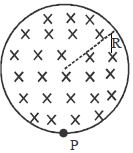
A uniform magnetic field of induction $B$ is confined to a cylinder region of radius $R$. The magnetic field is increasing at a constant rate of $\frac{{dB}}{{dt}}\left( {T/s} \right)$. A proton of charge $e$ and mass $m$ is placed at point $P$ on periphery. Its acceleration is
The amplitude of a simple pendulum, oscillating in air with a small spherical bob, decreases from $10\, cm$ to $8\, cm$ in $40\, seconds$ . Assuming that Stokes law is valid, and ratio of the coefficient of viscosity of air to that of carbon dioxide is $1.3$ . The time in which amplitude of this pendulum will reduce from $10\, cm$ to $5\, cm$ in carbon dioxide will be close to ..... $s$ $(ln\, 5 = 1.601,ln\, 2 = 0 .693)$
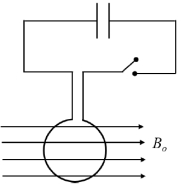
A circular coil of radius $R$ and $N$ turns has negligible resistance. As shown in the schematic figure, its two ends are connected to two wires and it is hanging by those wires with its plane being vertical. The wires are connected to a capacitor with charge $Q$ through a switch. The coil is in a horizontal uniform magnetic field $B_0$ parallel to the plane of the coil. When the switch is closed, the capacitor gets discharged through the coil in a very short time. By the time the capacitor is discharged fully, magnitude of the angular momentum gained by the coil will be (assume that the discharge time is so short that the coil has hardly rotated during this time)-
Which of the following is not the unit of energy