Question
Two interfering waves have the same wavelength, frequency, and amplitude. They are traveling in the same direction but are $90^o$ out of phase. Compared to the individual waves, the resultant wave will have the same.

Answer

let the equation of wave be $A \sin (k x-\omega t)$ and $A \sin \left(k x-\omega t+\frac{\pi}{2}\right)$ which can also be written as $A \cos (k x-\omega t)$

so the resultant is $S=A \sin (k x-\omega t)+A \cos (k x-\omega t)$

by observing both the waves on the graph we can see that the shape of the wave remain the same but with higher amplitude

$S=\sqrt{A^{2} \sin ^{2}(k x-\omega t)+A^{2} \cos ^{2}(k x-\omega t)+2 A^{2} \sin (k x-\omega t) \cos (k x-\omega t)}$

$S=\sqrt{A^{2}+2 A^{2} \sin (k x-\omega t) \cos (k x-\omega t)}$

$\sin 2 A=2 \sin A \cos A$ and $\sin 2 A=1-2 \sin ^{2} A$

$S=A \sqrt{1+\sin (2 k x-2 \omega t)}=A \sqrt{1+1-2 \sin ^{2}(k x-\omega t)}=\sqrt{2} A \cos (k x-\omega t)$

Need a full question paper?

Generate a complete, print-ready paper with questions like this in minutes — across 16+ boards, with answer keys.
Start Generating Free

Similar questions

Two cities are $150\,\, km$ apart. Electric power is sent from one city to another city through copper wires. The fall of potential per $km$ is $8\,\, volt$ and the average resistance per km is $0.5 \,\,\Omega .$ The power loss in the wire is
In order to shift a body of mass $m$ from a circular orbit of radius $3R$ to a higher radius $5R$ around the earth, the work done is
If the refractive indices of a prism for red, yellow and violet colours be $1.61, 1.63$ and $1.65$ respectively, then the dispersive power of the prism will be
The resultant of two rectangular simple harmonic motions of the same frequency and equal amplitudes but differing in phase by $\frac{\pi }{2}$ is
A radio transmitter radiates $1 kW$ power at a wavelength $198.6 $ metres. How many photons does it emit per second
A shell, in flight, explodes into four unequal parts. Which of the following is conserved?
Two thin metallic spherical shells of radii ${r}_{1}$ and ${r}_{2}$ $\left({r}_{1}<{r}_{2}\right)$ are placed with their centres coinciding. A material of thermal conductivity ${K}$ is filled in the space between the shells. The inner shell is maintained at temperature $\theta_{1}$ and the outer shell at temperature $\theta_{2}\left(\theta_{1}<\theta_{2}\right)$. The rate at which heat flows radially through the material is :-
When a pressure of $100$ atmosphere is applied on a spherical ball, then its volume reduces to $0.01\%$. The bulk modulus of the material of the rubber in $dyne/c{m^2}$ is
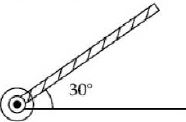
A rod of length $50\,cm$ is pivoted at one end. It is raised such that if makes an angle of $30^o$ fro the horizontal as shown and released from rest. Its angular speed when it passes through the horizontal (in $rad\,s^{-1}$ ) will be $(g = 10\,ms^{-2})$
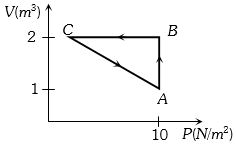
An ideal gas is taken through the cycle $A → B → C → A$, as shown in the figure. If the net heat supplied to the gas in the cycle is $5 \ J$, the work done by the gas in the process $C → A$ is ....... $J$