Question
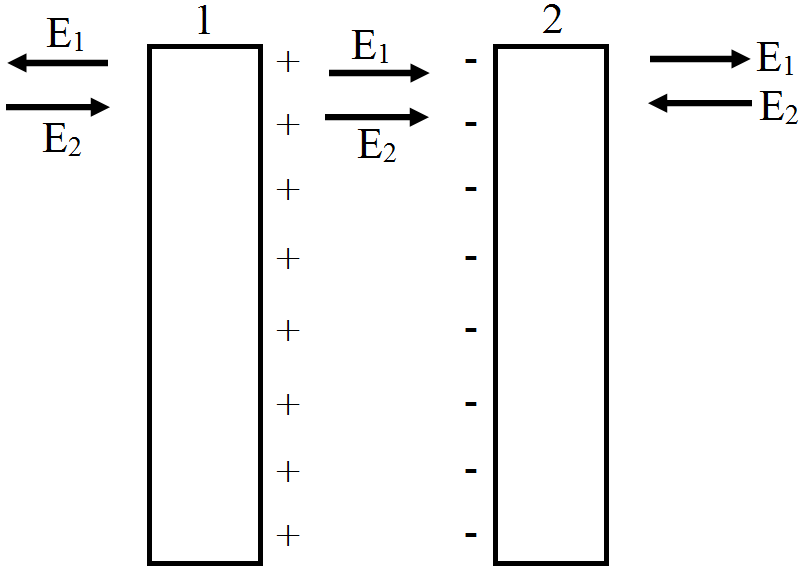
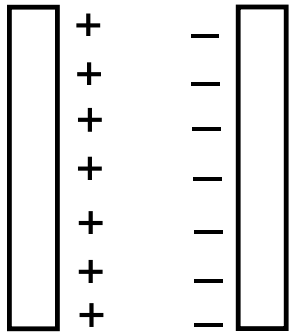
Two large conducting plates are placed parallel to each other and they carry equal and opposite charges with surface density $\sigma$ as shown in figure. Find the electric field:
  1. At the left of the plates.
  2. In between the plates.
  3. At the right of the plates.

Answer


Given :

Surface charge density on the plates $=\sigma$

The electric field due to plate 1, $\text{E}_1=\frac{\sigma}{2\in_0}$

The electric field due to plate 2, $\text{E}_2=\frac{\sigma}{2\in_0}$

  1. The strength of the electric field due to both the plates will be same but their directions will be opposite to each other on any point at the left of the two plates.

Thus, the net electric field at a point on the left of plate 1 $=\frac{\sigma}{2\in_0}-\frac{\sigma}{2\in_0}=0$

  1. Here the direction of the fields will be same. So, they will add up to give the resultant field in this region.

Total electric field:

$\frac{\sigma}{2\in_0}+\frac{\sigma}{2\in_0}=\frac{\sigma}{\in_0}$

  1. The strength of the electric field due to both the plates will be same but their directions will be opposite to each other at any point on the right of the two plates.

Thus, the net electric field at a point on the left of plate 2 $=\frac{\sigma}{2\in_0}-\frac{\sigma}{2\in_0}=0$
Need a full question paper?

Generate a complete, print-ready paper with questions like this in minutes — across 16+ boards, with answer keys.

Start Generating Free

Similar questions

A pump on the ground floor of a building can pump up water to fill a tank of volume 30m3 in 15min. If the tank is 40m above the ground, and the efficiency of the pump is 30%, how much electric power is consumed by the pump?
Shows plot of $\frac{\text{PV}}{\text{T}}$ versus P for 1.00 × 10⁻³kg of oxygen gas at two different temperatures:

If we obtained similar plots for 1.00 × 10⁻³kg of hydrogen, would we get the same value of $\frac{\text{PV}}{\text{T}}$ at the point where the curves meet on the y-axis? If not, what mass of hydrogen yields the same value of $\frac{\text{PV}}{\text{T}}$ (for low pressure high temperature region of the plot)? (Molecular mass of H2 = 2.02u, of O2 = 32.0u, R = 8.31J mo1-1K-1).

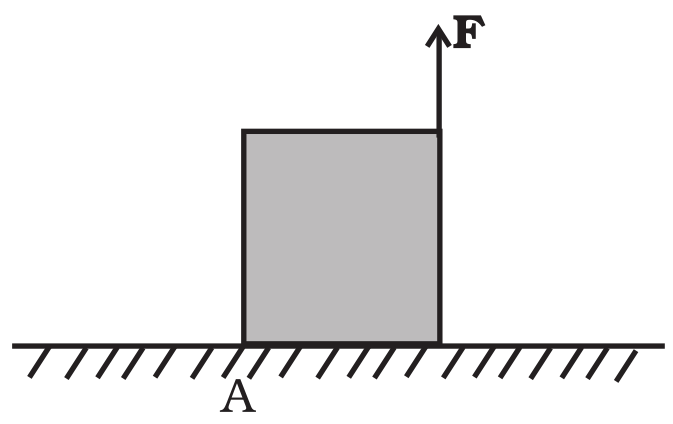
A uniform cube of mass m and side a is placed on a frictionless horizontal surface. A vertical force F is applied to the edge as shown in match the following (most appropriate choice):

a. $\frac{\text{mg}}{4}<\text{F}<\frac{\text{mg}}{2}$ i. Cube will move up.
b. $\text{F}>\frac{\text{mg}}{2}$ ii. Cube will not exhibit motion.
c. $\text{F}>\text{mg}$ iii. Cube will begin to rotate and slip at A.
d. $\text{F}=\frac{\text{mg}}{4}$ iv. Normal reaction effectively at $\frac{\text{a}}{3}$


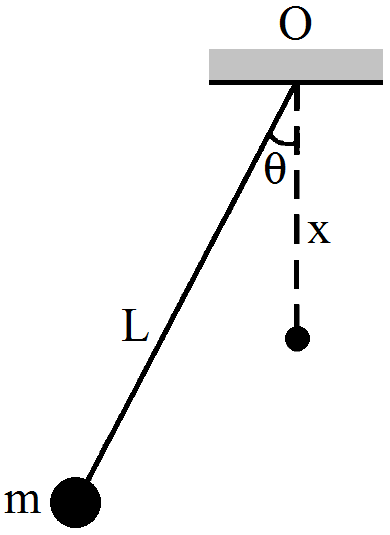
A simple pendulum of length L having a bob of mass m is deflected from its rest position by an angle $\theta$ and released (figure). The string hits a peg which is fixed at a distance x below the point of suspension and the bob starts going in a circle centred at the peg.
  1. Assuming that initially the bob has a height less than the peg, show that the maximum height reached by the bob equals its initial height.
  2. If the pendulum is released with $\theta=90^\circ$ and $\text{x}=\frac{\text{L}}{2}$ find the maximum height reached by the bob above its lowest position before the string becomes slack.
  3. Find the minimum value of $\frac{\text{x}}{\text{L}}$ for which the bob goes in a complete circle about the peg when the pendulum is released from $\theta=90^\circ.$

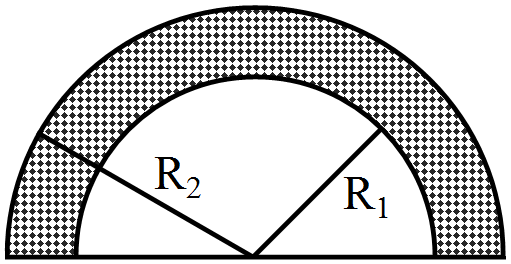
Find the centre of mass of a uniform plate having semicircular inner and outer boundaries of radii R1 and R2.

A pump on the ground floor of a building can pump up water to fill a tank of volume 30m3 in 15min. If the tank is 40m above the ground, and the efficiency of the pump is 30%, how much electric power is consumed by the pump?
An object may be regarded to be at rest or in motion depending on the frame of reference chosen to view the object. Because of length contraction it would mean that the same rod may have two different lengths depending on the state of the observer. Is this true?
A particle P starts its motion at t = 0 and moves along a circle as shown in figure with period of 4s. Write down the equation representing S.H.M. of the particle P.
The two blocks in an Atwood machine have masses 2.0kg and 3.0kg. Find the work done by gravity during the fourth second after the system is released from rest.
A spherical ball of mass m and radius r rolls without slipping on a rough concave surface of large radius R. It makes small oscillations about the lowest point, Find the time period.