MCQ
Two light beams superimposed each other constructively this results in:
  • A
    A loss of kinetic energy
  • B
    The destruction of the waves
  • C
    The reversal of the direction of the waves
  • A larger wave

Answer

Correct option: D.
A larger wave

For constructive interference,
$A_R=A_1+A_2$
Due to the constructive interference of the superimposing waves, resultant wave of larger amplitude is obtained and hence constructive interference results in the larger wave.

Need a full question paper?

Generate a complete, print-ready paper with questions like this in minutes — across 16+ boards, with answer keys.
Start Generating Free

Similar questions

In Young's double slit experiment, at a fixed point where $\lambda$ is path difference $=\lambda / 6(\lambda=$ wavelength of the light used), the intensity is I. If $I _0$ is the maximum intensity then $I / I_0$ is equal to :
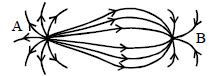
The spatial distribution of the electric field due to two charges $(A,\,B)$ is shown in figure. Which one of the following statements is correct ?
If a 30 V, 90 W bulb is to be worked on a 120 V line, a resistance of how many ohms should be connected in series with the bulb
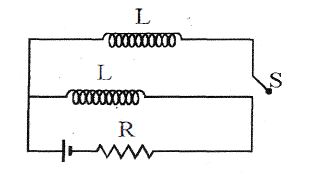
Initially the switch $S$ is open and energy stored in inductance $L$ connected in series with battery is $E$ , Now switch $S$ is closed. The energy stored in both the inductors after long time is
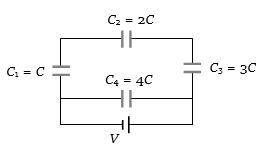
A network of four capacitors of capacity equal to ${C_1} = C,\,\,{C_2} = 2C,\,{C_3} = 3C$ and ${C_4} = 4C$ are conducted in a battery as shown in the figure. The ratio of the charges on ${C_2}$ and ${C_4}$ is
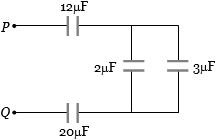
In the circuit diagram shown in the adjoining figure, the resultant capacitance between $P$ and $Q$ is........$\mu F$
The $“K_{\alpha} ”$ $X-$ rays emission line of tungsten occurs at $\lambda = 0.021 \,nm.$ The energy difference between $K$ and $L$ levels in this atom is about
Consider the following statements A to B and identify the correct answer
A. Polarised light can be used to study the helical surface of nucleic acids.
B. Optics axis is a direction and not any particular line in the crystal
The three basic properties possessed by the electric charge are:
Rutherford performed his alpha scattering experiment using: