MCQ
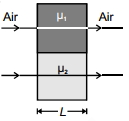
Two light rays initially in same phase travel through two media of equal length $L$ having refractive index $m _1$ and $m_2\left(m_1 > m_2\right)$ as shown in figure. If the wave length of light rays in air is $1$ , the phase difference of the emerging rays is given by
  • A
    $\frac{L \mu_1}{\lambda \mu_2}$
  • B
    $\frac{\left(\mu_1-\mu_2\right) L}{2 \pi \lambda}$
  • $\frac{2 \pi\left(\mu_1-\mu_2\right) L}{\lambda}$
  • D
    $0$

Answer

Correct option: C.
$\frac{2 \pi\left(\mu_1-\mu_2\right) L}{\lambda}$
c
(c)

Path difference between the emerging rays $=\mu_1 L -\mu_2 L$

$\frac{\phi}{2 \pi}=\frac{\left(\mu_1-\mu_2\right) L}{\lambda}$

$\therefore \phi=\frac{\left(\mu_1-\mu_2\right) L}{\lambda}$

Need a full question paper?

Generate a complete, print-ready paper with questions like this in minutes — across 16+ boards, with answer keys.

Start Generating Free

Similar questions

At the top of the trajectory of a projectile, the directions of its velocity and acceleration are
A parallel plate capacitor has a capacity $C$. The separation between the plates is doubled and a dielectric medium is introduced between the plates. If the capacity now becomes $2C$, the dielectric constant of the medium is
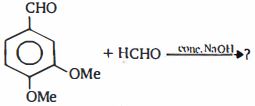
The following reaction gives
The focal length of objective and eye lens of a astronomical telescope are respectively $2 \,m$ and $5\, cm$. Final image is formed at

$(i)$ least distance of distinct vision

$(ii)$ infinity. The magnifying power in both cases will be


The focal length of the field lens (which is an achromatic combination of two lenses) of telescope is $90 cm$. The dispersive powers of the two lenses in the combination are $0.024$ and $0.036.$ The focal lengths of two lenses are
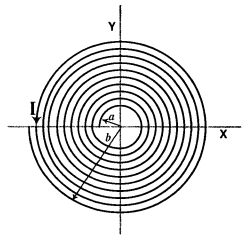
A long insulated copper wire is closely wound as a spiral of ' $N$ ' turns. The spiral has inner radius ' $a$ ' and outer radius ' $b$ '. The spiral lies in the $X-Y$ plane and a steady current ' $I$ ' flows through the wire. The $Z$-component of the magnetic field at the center of the spiral is 
A transverse harmonic wave on a string is given by $y(x, t)=5 \sin (6 t+0.003 x)$ where $x$ and $y$ are in $cm$ and $t$ in $sec$. The wave velocity is $...........\,ms ^{-1}$.
Lenz's law is consequence of the law of conservation of
In figure, two blocks $M$ and $m$ are tied together with an inextensible and light string. The mass $M$ is placed on a rough horizontal surface with coefficient of friction $\mu$ and the mass $m$ is hanging vertically against a smooth vertical wall. The pulley is frictionless. When the downward acceleration of the elevator becomes equal to $g$, then
Assertion : It is not possible to use ${}^{35}Cl$ as the fuel for fusion energy.

Reason : The binding energy of ${}^{35}Cl$ is too small.