MCQ
Two lighter nuclei combine to form a comparatively heavier nucleus by the relation given below:

${ }_{1}^{2} X +{ }_{1}^{2} X ={ }_{2}^{4} Y$

The binding energies per nucleon ${ }_{1}^{2} X$ and ${ }_{2}^{4} Y$ are $1.1\,MeV$ and $7.6\,MeV$ respectively. The energy released in this process is $MeV$.

  • A
    $25$
  • $26$
  • C
    $23$
  • D
    $22$

Answer

Correct option: B.
$26$
b
Energy released in the given process $=$ Binding energy of product $-$ Binding energy of reactants

$=7.6 \times 4-(1.1 \times 2) \times 2$

$=30.4-4.4$

$=26\,MeV$

Need a full question paper?

Generate a complete, print-ready paper with questions like this in minutes — across 16+ boards, with answer keys.

Start Generating Free

Similar questions

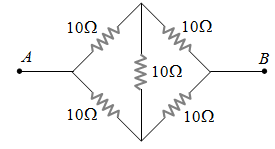
The effective resistance between points A and B is
A beam of light from a source $L$ is incident normally on a plane mirror fixed at a certain distance $x$ from the source. The beam is reflected back as a spot on a scale placed just above the source $L.$ When the mirror is rotated through a small angle $\theta$, the spot of the light is found to move through a distance $y$ on the scale. The angle $\theta$ is given by
The total momentum of electrons in a straight wire of copper of length $1\, metre$ carrying a current of $16\, A$ is
A particle of mass $m$ carrying charge $q$ is accelerated by a potential difference $V$. It enters perpendicularly in a region of uniform magnetic field $B$ and executes circular arc of radius $R$, then $\frac{q}{m}$ equals
This questions has statement$-1$ and statement$-2$. Of the four choices given after the statements, choose the one that best describe the two statements.
An insulating solid sphere of radius $R$ has a uniformly
positive charge density $\rho$. As a result of this uniform charge distribution there is a finite value of electric potential at the centre of the sphere, at the surface of the sphere and also at a point out side the sphere. The electric potential at infinite is zero.

Statement$ -1$ : When a charge $q$ is take from the centre of the surface of the sphere its potential energy changes by  $\frac{{q\rho }}{{3{\varepsilon _0}}}$

Statement$ -2$ : The electric field at a distance $r(r < R)$  from centre of the sphere is $\frac{{\rho r}}{{3{\varepsilon _0}}}$

Two identical coils of radius $R$ and number of turns $N$ are placed perpendicular to each others in such a way that they have common centre. The current through them are $I$ and $I\sqrt 3$ . The resultant intensity of magnetic field at the centre of the coil will be  (in $weber/m^2)2$
In Young's double slit experiment, if the two slits are illuminated with separate sources, no interference pattern is observed because
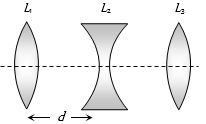
Three lenses $L_1, L_2, L_3$ are placed co-axially as shown in figure. Focal length's of lenses are given $30\, cm, 10\, cm$ and $5\, cm$ respectively. If a parallel beam of light falling on lens $L_1$, emerging $L_3$ as a convergent beam such that it converges at the focus of $L_3$. Distance between $L_1$ and $L_2$ will be......$cm$
The focal lengths of the objective and eye-lens of a microscope are 1 cm and 5 cm respectively. If the magnifying power for the relaxed eye is 45, then the length of the tube is
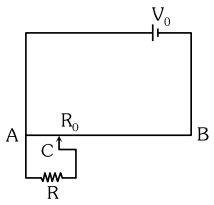
The sliding contact $C$ is at one fourth of the length of the potentiometer wire $( AB )$ from $A$ as shown in the circuit diagram. If the resistance of the wire $AB$ is $R _0$, then the potential drop $( V )$ across the resistor $R$ is