Question
Two like parallel forces $\overrightarrow{a}$ and$\overrightarrow{b}$ act on a rigid body at A and B respectively. If $\overrightarrow{P}$ and $\overrightarrow{Q}$ are interchanged in position, show that the point of application of the resultant will be displaced through a distance $\frac{P -Q}{P + Q}.AB$
Answer

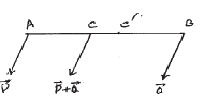
Let the forces $\overrightarrow{P}$ and $\overrightarrow{Q}$ act at A and B respectively. Let C be the point from where resultant passes
$\therefore \frac{\overrightarrow{P}}{CB} = \frac{\overrightarrow{Q}}{AC}= \frac{\overrightarrow{P} + \overrightarrow{Q}}{AB}$
$\Rightarrow AC = \frac{\overrightarrow{Q}.{AB}}{\overrightarrow{P} + \overrightarrow{Q}}$
When the forces are interchanged in position, let ' be the point from where resultant passes, then
$\Rightarrow AC = \frac{\overrightarrow{P}.{AB}}{\overrightarrow{P} + \overrightarrow{Q}}$
$\text{As P>Q, we get CC'} = AC'-AC \frac{\overrightarrow{P} - \overrightarrow{Q}}{\overrightarrow{P} + {\overrightarrow{Q}}} \times AB$

Need a full question paper?

Generate a complete, print-ready paper with questions like this in minutes — across 16+ boards, with answer keys.

Start Generating Free

Similar questions

Evaluate the following integrals:
$\int\frac{1}{(\text{x}^2-1)\sqrt{\text{x}^2+1}}\text{ dx}$
If $ \vec{\text{a}}=2\hat{\text{i}}-\hat{\text{j}}-2\hat{\text{k}}\ \text{and}\ \vec{\text{b}}=7\hat{\text{i}}+2\hat{\text{j}}-3\hat{\text{k}}, $ then express $ \overrightarrow{\text{b}}$ in the form of $\overrightarrow{\text{b}}=\ \overrightarrow{\text{b}}_1+\overrightarrow{\text{b}}_2,$ where $ \overrightarrow{\text{b}}_1$ is parallel to $\overrightarrow{\text{a}}$ and $ \overrightarrow{\text{b}}_2$ is perpendicular to$\overrightarrow{\text{a}}$.
If $\text{y}=(\sin\text{x}-\cos\text{x})^{\sin\text{x}-\cos\text{x}},\frac{\pi}{4}<\text{x}<\frac{3\pi}{4},$ find $\frac{\text{dy}}{\text{dx}}$
Evaluate the following integrals:
$\int\limits_{0}^{\frac{\pi}{2}}\frac{\sin\text{x}\cos\text{x}}{1+\sin^4\text{x}}\text{ dx}$
Find $\frac{\text{dy}}{\text{dx}},$ when
$\text{x}=\text{a}(\cos\theta+\theta\sin\theta)$ and $\text{y}=\text{a}(\sin\theta-\theta\sin\theta-\theta\cos\theta)$
If $x^x + y^x = 1$, prove that $\frac{\text{dy}}{\text{dx}}=-\frac{\text{y}(\text{y}+\text{x}\log\text{y})}{\text{x}(\text{y}\log\text{x}+\text{x})}$
Find the area bounded by the lines y = 4x + 5, y 5 - x and 4y = x + 5.
Find the maximum and the minimum values, if any, without using derivaives of the following functions:f(x) = sin2x + 5 on R.
Evaluate the following integrals:
$\int\frac{1}{(\text{x}^2+2\text{x}+10)^2}\text{ dx}$
If $\vec{\text{p}}$ and $\vec{\text{q}}$ are unit vectors forming an angle of 30°; find the area of the parallelogram having $\vec{\text{a}}=\vec{\text{p}}+2\vec{\text{q}}$ and $\vec{\text{b}}=2\vec{\text{p}}+\vec{\text{q}}$ as its diagonals.