Question
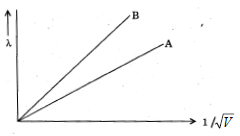
Two lines, A and B, in the plot given below show. the variation of de Broglie wavelength, $\lambda$ versus $1/\sqrt{\text{V}},$ where V is the accelerating potential difference, for two particles carrying the same charge. Which one of two represents a particle of smaller mass?

Answer

$\lambda = \frac{\text{h}}{\sqrt{2\text{meV}}}$
Straight line denoted by ‘B’.

Need a full question paper?

Generate a complete, print-ready paper with questions like this in minutes — across 16+ boards, with answer keys.

Start Generating Free

Similar questions

How is the radius of a nucleus related to its mass number?###Write the relation between radius R and mass number A of a nucleus.
Answer the following questions:
The earth may have even reversed the direction of its field several times during its history of 4 to 5 billion years. How can geologists know about the earth’s field in such distant past?
State de-Broglie hypothesis.
A Gaussian surface contains three charges (-q), (+2q) and (-q). Evaluate net electric flux through the surface.
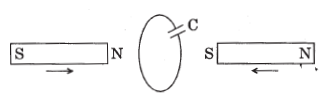
Two bar magnets are quickly moved towards a metallic loop connected across a capacitor 'C' as shown in the figure. Predict the polarity of the capacitor.

Why does a magnetic force exerts on a conducting wire kept in a magnetic field on passing current through it?
Name the characteristics of electromagnetic waves that:
  1. Increases.
  2. Remains constant.
In the electromagnetic spectrum as one moves from radio wave region towards ultraviolet region.
The velocity of a particle is towards west at an instant. Its acceleration is not towards west, not towards east, not towards north and not towards south. Give an example of this type of motion.
Raindrops of radius 1mm and mass 4mg are falling with a speed of 30m/s on the head of a bald person. The drops splash on the head and come to rest. Assuming equivalently that the drops cover a distance equal to their radii on the head, estimate the force exerted by each drop on the head.
A charged particle is projected at a very high speed perpendicular to a uniform magnetic field. The particle will:
  1. Move along a circle.
  2. Move along a curve with increasing radius of curvature.
  3. Move along a curve with decreasing radius of curvature.
  4. Move along a straight line.