Question
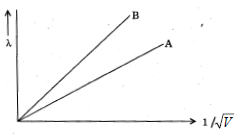
Two lines, A and B, in the plot given below show. the variation of de Broglie wavelength, $\lambda$ versus $1/\sqrt{\text{V}},$ where V is the accelerating potential difference, for two particles carrying the same charge. Which one of two represents a particle of smaller mass?

Answer

$\lambda = \frac{\text{h}}{\sqrt{2\text{meV}}}$
Straight line denoted by ‘B’.

Need a full question paper?

Generate a complete, print-ready paper with questions like this in minutes — across 16+ boards, with answer keys.

Start Generating Free

Similar questions

Some of $\alpha$-particles out of $\alpha$-particles incident on gold foil, returned back to their path after scattering. Give the reason.
Name the dielectric whose molecules have:
  1. Non-zero,
  2. Zero dipole moment.
The frequency of oscillation of the electric field vector of a certain electromagnetic wave is 5 × 10¹⁴Hz. What is the frequency of oscillation of the corresponding magnetic field vector and to which part of the electromagnetic spectrum does it belong?
Electromotive forces of two cells are $\varepsilon_1$ and $\varepsilon_2$ and their internal resistances are $r_1$ and $r_2$ Both cells are joined in lateral combination. Write equivalent electromotive force of this combination.
A biconvex lens made of a transparent material of refractive index 1.25 is immersed in water of refractive index 1.33. Will the lens behave as a converging or a diverging lens? Give reason.
Answer the following questions regarding earth’s magnetism:
The angle of dip at a location in southern India is about 18° Would you expect a greater or smaller dip angle in Britain?
How electromagnetic radio waves are produced?
If we walk barefoot on a nylon mat for some time and touch the metal handle of a door, we get an electric shock. Why does this happen?
What will be the magnitude of induced current in circular loop KLMN of radius $r$ if constant current of $1 A$ is passed in straight wire $P Q$ ?
Image
Two alternating currents are given by, $\text{i}_\text{i}=\text{i}_0\sin\omega\text{t}$ and $\text{i}_\text{i}=\text{i}_0\sin\Big(\omega\text{t}+\frac{\pi}{3}\Big)$ Will the rms values of the currents be equal or different?