Question
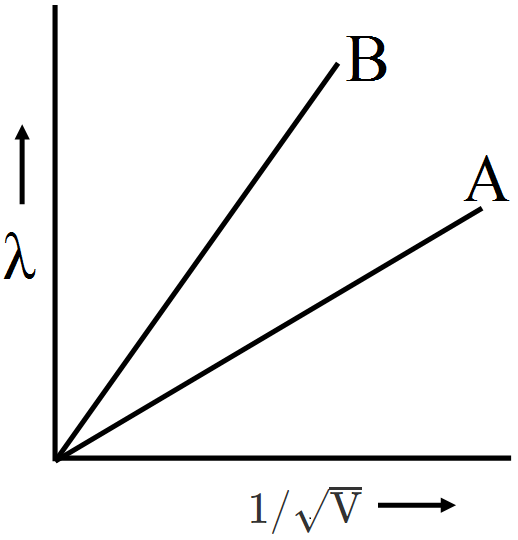
Two lines A and B shown in the graph represent the de Broglie wavelength $(\lambda)$ as a function of $\frac{1}{\sqrt{\text{V}}}$ (V is the accelerating potential) for two particles having the same charge. Which of the two represents the particle of smaller mass?
Answer

de Broglie wavelength $\lambda=\frac{\text{h}}{\sqrt{2\text{mqV}}}$ or $\lambda=\frac{\text{h}}{\sqrt{2\text{mq}}}.\frac{1}{\sqrt{\text{V}}}$
The graph of $\lambda$ versus $\frac{1}{\sqrt{\text{V}}}$ is a straight line of slope $\frac{\text{h}}{\sqrt{2\text{mq}}}\propto\frac{1}{\sqrt{\text{m}}}.$ The slope of line B is large, so particle B has smaller mass.

Need a full question paper?

Generate a complete, print-ready paper with questions like this in minutes — across 16+ boards, with answer keys.

Start Generating Free