Question
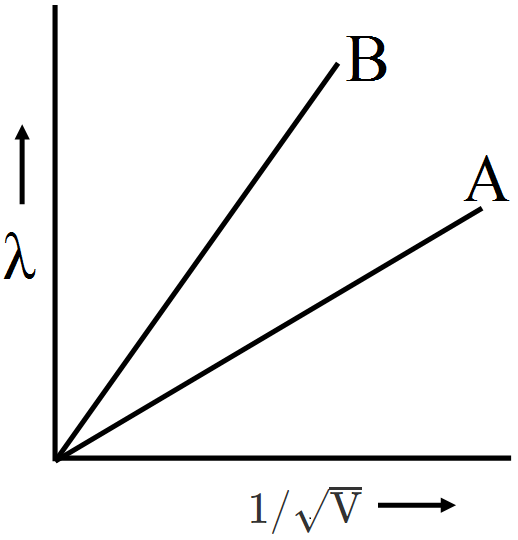
Two lines A and B shown in the graph represent the de Broglie wavelength $(\lambda)$ as a function of $\frac{1}{\sqrt{\text{V}}}$ (V is the accelerating potential) for two particles having the same charge. Which of the two represents the particle of smaller mass?
Answer

de Broglie wavelength $\lambda=\frac{\text{h}}{\sqrt{2\text{mqV}}}$ or $\lambda=\frac{\text{h}}{\sqrt{2\text{mq}}}.\frac{1}{\sqrt{\text{V}}}$
The graph of $\lambda$ versus $\frac{1}{\sqrt{\text{V}}}$ is a straight line of slope $\frac{\text{h}}{\sqrt{2\text{mq}}}\propto\frac{1}{\sqrt{\text{m}}}.$ The slope of line B is large, so particle B has smaller mass.

Need a full question paper?

Generate a complete, print-ready paper with questions like this in minutes — across 16+ boards, with answer keys.

Start Generating Free

Similar questions

A power transmission line feeds input power at 2300V to a stepdown transformer with its primary windings having 4000 turns. What should be the number of turns in the secondary in order to get output power at 230 V?
A pair of adjacent coils have a mutual inductance of 1.5 H. If the current in one coil changes from 0 to 20 A in 0.5 s, what is the change of the flux linkage with the other coil?
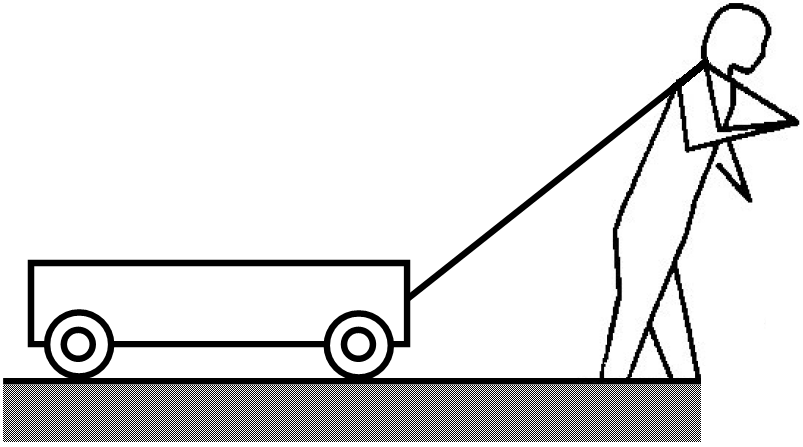
Figure shows a boy pulling a wagon on a road. List as many forces as you can which are relevant with this figure. Find the pairs of forces connected by Newton's third law of motion.

An electric field $\vec{\text{E}}=(\vec{\text{i}}20+\vec{\text{j}}30)\text{N}\text{C}^{-1}$ exists in the space. If the potential at the origin is taken to be zero, find the potential at (2m, 2m).
Explain $n$-type and $p$-type semiconductors on the basis of band theory.
It is said that the separation between the two charges forming an electric dipole should be small. Small compared to what?
Consider a gold nucleus to be a sphere of radius 6.9 fermi in which protons and neutrons are distributed. Find the force of repulsion between two protons situated at largest separation. Why do these protons not fly apart under this repulsion?
State factors on which the resistance of a conductor depends.
Equipotential surfaces are 5 cm apart from each other. How much work will be required to move a 500 µC charge between distant points?
When we can consider a charged particle as point electric charge ?