Two long parallel copper wires carry currents of $5\,A$ each in opposite directions. If the wires are separated by a distance of $0.5\,m$, then the force between the two wires is
Easy


Download our appand get started for free
Experience the future of education. Simply download our apps or reach out to us for more information. Let's shape the future of learning together!No signup needed.*
Similar Questions
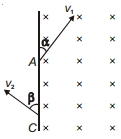
- 1A particle of charge $-q$ and mass $m$ enters a uniform magnetic field $\vec{B}$ at $A$ with speed $v_1$ at an angle $\alpha$ and leaves the field at $C$ with speed $v_2$ at an angle $\beta$ as shown. ThenView Solution
- 2A $36 \,\Omega$ galvanometer is shunted by resistance of $4\,\Omega$. The percentage of the total current, which passes through the galvanometer isView Solution
- 3The sensitivity of a Galvenometer of resistance $171\,\Omega $ becomes $20\,times$ when we used shunt of $x \,\Omega .$ Find $x$ ................. $\Omega$View Solution
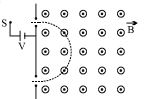
- 4A mass spectrometer is a device which select particle of equal mass. An iron with electric charge $q > 0$ and mass $m$ starts at rest from a source $S$ and is accelerated through a potential difference $V$. It passes $\rho$ through a hole into a region of constant magnetic field $\vec B\,$ perpendicular to the plane of the paper as shown in the figure. The particle is deflected by the magnetic field and emerges through the bottom hole at a distance $d$ from the top hole. The mass of the particle isView Solution
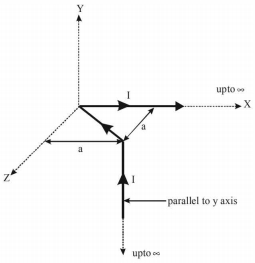
- 5View SolutionThe magnetic field at the origin due to the current flowing in the wire is -
- 6View SolutionWhich of the field patterns given below is valid for electric field as well as for magnetic field?
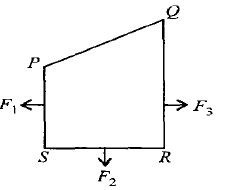
- 7A closed loop $PQRS$ carrying a current is placed in a uniform magnetic field. If the magnetic forces on segments $PS, SR$ and $RQ$ are $F_1, F_2$ and $F_3$ respectively and are in the plane of the paper and along the directions shown, the force on the segment $QP$ isView Solution
- 8A particle of specific charge $(q/m)$ is projected from the origin of coordinates with initial velocity $[ui - vj]$. Uniform electric magnetic fields exist in the region along the $+y$ direction, of magnitude $E$ and $B.$ The particle will definitely return to the origin once ifView Solution
- 9A long straight wire carries an electric current of $2\,A$. The magnetic induction at a perpendicular distance of $5\,m$ from the wire isView Solution
- 10A galvenometer has a resistance of $100 \,\Omega $ and a full scale range of $50\, \mu A$ . It can be used as a voltmeter or as a high range ammeter provided a resistance is added to it. Pick the correct range and resistance combinationView Solution