MCQ
Two long parallel glass plates has water between them. Contact angle between glass and water is zero. If separation between the plates is $'d'$ ( $d$ is small). Surface tension of water is $'T'$ . Atmospheric pressure = $P_0$ . Then pressure inside water just below the air water interface is 
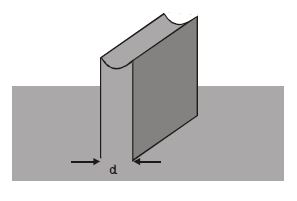
  • A
    ${P_0} + \frac{{2T}}{d}$
  • B
    ${P_0} + \frac{{2T}}{{\left( {d/2} \right)}}$
  • C
    ${P_0} + \frac{{8T}}{d}$
  • ${P_0} - \frac{{2T}}{d}$

Answer

Correct option: D.
${P_0} - \frac{{2T}}{d}$
d

Need a full question paper?

Generate a complete, print-ready paper with questions like this in minutes — across 16+ boards, with answer keys.

Start Generating Free

Similar questions

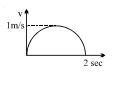
Velocity-time graph for a car is semicircle as shown here. Which of the following is correct :
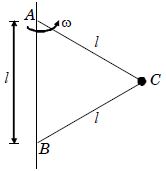
As shown in the figure, two strings of length $l$ each are attached with a vertical axis $AB$ of length $l$. Strings are $AC$ and $BC$. At point $C$ a point mass m is attached. Mass rotates about axis with angular velocity. Tensions in $AB$ and $BC$ are $T_1$ and $T_2$ respectively. Choose the $CORRECT$ alternative :-
The total kinetic energy of a body of mass $10\ kg$ and radius $0.5\ m$ moving with a velocity of $2\ m/s$ without slipping is $32.8\ joule$.  The radius of gyration of the body is  .......... $m$
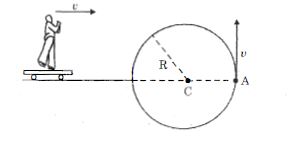
A boy is moving with a constant speed $v$ on a small trolley towards a distant circle as shown in the figure. A point mass is moving on the circle with a constant speed $v$, what is the frequency of change in magnitude of relative velocity of the point mass, as observed by the boy.
When a car at high speed makes a sharp turn, the driver in the car tends to get thrown in the direction opposite to that of the turn. This is due to which property?
A car $'A'$ chasing another car $'B'$ with a speed of $20\, m/s$ sounding a horn of $180\, Hz$. While both cars are moving towards a stationary siren of frequency $170\, Hz$. What is the speed of car $B$ so that it can't hear any beat ....$m/s$ (speed of sound $= 340\, m/s$)
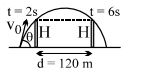
A projectile crosses two walls of equal height $H$ symmetrically as shown The angle of projection of the projectile is
Consider the following two statements.
  1. If heat is added to a system, its temperature must increase.
  2. If positive work is done by a system in a thermodynamic process, its volume must increase.
  1. Both A and B are correct.
  2. A is correct but B is wrong.
  3. B is correct but A is wrong.
  4. Both A and B are wrong.
Two vectors $\vec A$ and $\vec B$ have equal magnitudes. The magnitude of $(\vec A + \vec B)$ is $‘n’$ times the magnitude of $(\vec A - \vec B)$. The angle between $ \vec A$ and $\vec B$ is
At what temperature is the root mean square velocity of gaseous hydrogen molecules is equal to that of oxygen molecules at $47°C$ ..... $K$