MCQ
Two long parallel wires whose centres are $a$ distance $d$ apart carry equal currents in opposite directions. If the flux within wires is neglected, the inductance of such arrangement of wire of length $l$ and radius $a$ will be
  • $L = \frac{{{\mu _0}{\text{l}}}}{\pi }\,{\log _e}\,\frac{{d - a}}{a}$
  • B
    $L = \frac{{{\mu _0}{\text{l}}}}{\pi }\,{\log _e}\,\frac{d}{a}$
  • C
    $L = \frac{{{\mu _0}{\text{l}}}}{\pi }\,{\log _e}\,\frac{a}{d}$
  • D
    none

Answer

Correct option: A.
$L = \frac{{{\mu _0}{\text{l}}}}{\pi }\,{\log _e}\,\frac{{d - a}}{a}$
a
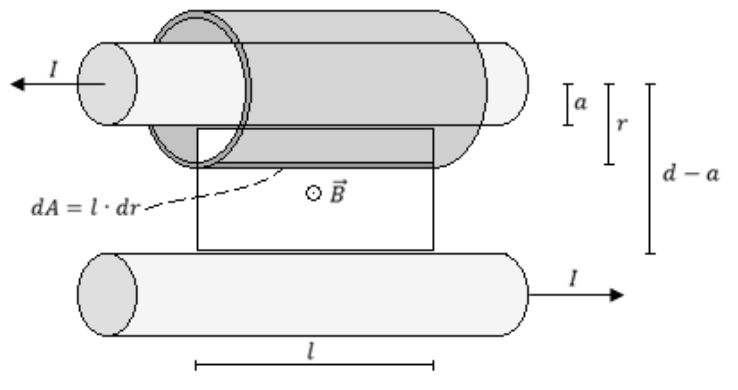
Using Ampere's law for one of the wires to obtain the magnetic field in terms of current $I$ and

the variable radius $r$ due to one of the wire

$\mu_{0} I =\oint \vec{B} \cdot \overrightarrow{d l}$

$=\int_{0}^{2 \pi} B r d \theta$

$\mu_{0} I =B(2 \pi r)$

$\Rightarrow \quad B =\frac{\mu_{0} I}{2 \pi r}$

Note that because of the symmetry of the setup, the total magnetic flux $(\phi)$ will be two times

generated by one of the wires. Then, we continue to use the relation between self inductance

and flux

$\phi_{\text {total}}=2 \int_{A} \vec{B} \cdot \overrightarrow{d A}$

$=2 \int_{a}^{d-a}\left(\frac{\mu_{0} I}{2 \pi r}\right) l d r$

$\phi_{\text {total}}=\frac{\mu_{0} I l}{\pi} \ln \left(\frac{d-a}{a}\right)$

Inductance, $L=\frac{\phi_{\text {total}}}{I}=\frac{\mu_{0} l}{\pi} \ln \left(\frac{d-a}{a}\right)$

Inductance per unit length, $\phi_{\text {total }}=\frac{\mu_{0}}{\pi} \ln \left(\frac{d-a}{a}\right)$
Need a full question paper?

Generate a complete, print-ready paper with questions like this in minutes — across 16+ boards, with answer keys.

Start Generating Free

Similar questions

Two liquids $A$ and $B$ have $\theta_{A}$ and $\theta_{B}$ as contact angles in a capillary tube. If $K=\cos \theta_{A} / \cos \theta_{B}$. then identify the correct statement :
The phase difference between the two particles situated on both the sides of a node is ... $^o$
Stationary waves are set up in air column. Velocity of sound in air is $330 m/s$ and frequency is $165\,Hz$. Then distance between the nodes is ... $m$
Two perfectly identical wires are in unison. When the tension in one wire is increased by $1\%$, then on sounding them together $3$ beats are heard in $2 \,sec$. The initial frequency of each wire is .... ${\sec ^{ - 1}}$
$10\  m$ is the total mass of a cannon that includs  all shell. Initial cannon is moving with velocity $10\  m$ is along a horizontal frictionless path. If cannon fires $'n$' shells of mass $m$ in the direction of motion of the cannon one by one with velocity $u$ with respect to ground. (neglect any friction force)
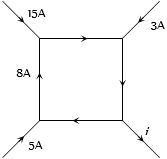
The figure shows a network of currents. The magnitude of currents is shown here. The current $i$ will be ................. $A$
The $k$  line of singly ionised calcium has a wavelength of $393.3 \,nm$ as measured on earth. In the spectrum of one of the observed galaxies, this spectral line is located at $401.8 \,nm$. The speed with which the galaxy is moving away from us, will be.....$km/s$
If a heavy nucleus has $N / Z$ ratio higher than that required for stability, then
A particle of mass $M$ and positive charge $Q$, moving with a constant velocity $\overrightarrow{ u }_1=4 \hat{ i } ms ^{-1}$, enters a region of uniform static magnetic field normal to the $x-y$ plane. The region of the magnetic field extends from $x=0$ to $x$ $=L$ for all values of $y$. After passing through this region, the particle emerges on the other side after $10$ milliseconds with a velocity $\overline{ u }_2=2(\sqrt{3} \hat{ i }+\hat{ j }) ms ^{-1}$. The correct statement$(s)$ is (are) :

$(A)$ The direction of the magnetic field is $-z$ direction.

$(B)$ The direction of the magnetic field is $+z$ direction

$(C)$ The magnitude of the magnetic field $\frac{50 \pi M }{3 Q }$ units.

$(D)$ The magnitude of the magnetic field is $\frac{100 \pi M}{3 Q}$ units.

A convex lens is put $10\, cm$ from a light source and it makes a sharp image on a screen, kept $10\, cm$ from the lens. Now a glass block (refractive index $1.5$) of $1.5\, cm$ thickness is placed in contact with the light source. To get the sharp image again, the screen is shifted by a distance $d$. Then $d$ is