Question
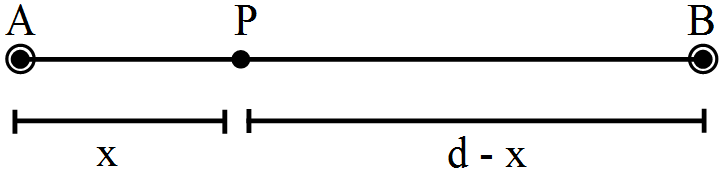
Two long straight parallel wires A and B separated by a distance d, carry equal current I flowing in same direction as shown in the figure.
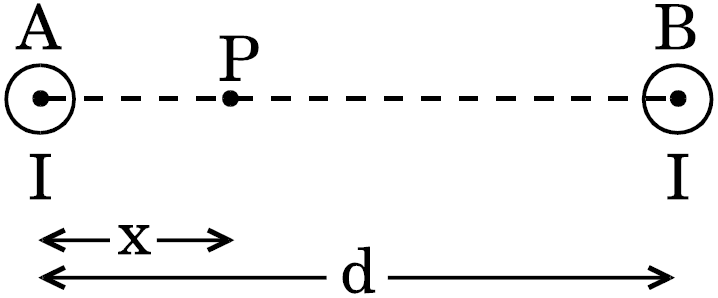
  1. Find the magnetic field at a point P situated between them at a distance x from one wire.
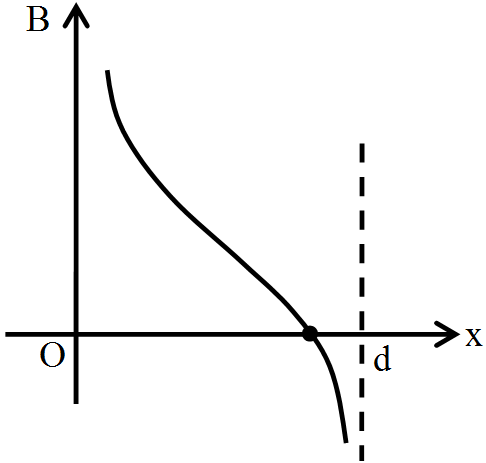
  2. Show graphically the variation of the magnetic field with distance x for 0 < x < d.
Answer

  1. $\text{B}_\text{P}=\text{B}_\text{A}+\text{B}_\text{B}=\frac{\mu_0\text{I}}{2\pi\text{x}}(\text{upwards})+\frac{\mu_0\text{I}}{2\pi(\text{fx)}}(\text{down)}$
$=\frac{\mu_0\text{I}}{2\pi}\Big[\frac{1}{\text{x}}-\frac{1}{\text{d}-\text{x}}\Big]$

$=\frac{\mu_0\text{I}}{2\pi}\Big[\frac{\text{d}-\text{x}-\text{x}}{\text{x}(\text{d}-\text{x)}}\Big]$

$=\frac{\mu_0\text{I}}{2\pi}\Big(\frac{\text{d}-2\text{x}}{\text{x}(\text{d}-\text{x)}}\Big)\text{upwards}+\frac{\mu_0\text{I}}{2\pi(\text{d}-\text{x})}(\text{down})$

$(1)\div(2)$

$\Rightarrow\frac{\text{mv}^2_\text{n}\text{r}_\text{n}}{\text{mv}_\text{n}\text{r}_\text{n}}=\Big(\frac{\text{ze}^2}{4\pi\varepsilon_0}\Big)\Big(\frac{2\pi}{\text{nh}}\Big)$

$\Rightarrow\text{speed of }\text{e}^-,$

As $\text{B}_\text{A}>\text{B}_\text{B}$
  1.  

Need a full question paper?

Generate a complete, print-ready paper with questions like this in minutes — across 16+ boards, with answer keys.

Start Generating Free

Similar questions

Find the average frictional force needed to stop a car weighing 500kg in a distance of 25m if the initial speed is 72km/ h.
A cylindrical capacitor is constructed using two coaxial cylinders of the same length 10cm and of radii 2mm and 4mm:
  1. Calculate the capacitance.
  2. Another capacitor of the same length is constructed with cylinders of radii 4mm and 8mm. Calculate the capacitance.
Determine the number density of donor atoms which have to be added to an intrinsic germanium semiconductor to produce an n-type semiconductor of conductivity $5 \Omega^{-1} cm^{-1}$, given that the mobility of electron in $n-$type Ge is $3900 cm^2 /$ vs. Neglect the contribution of holes to conductivity.
The minimum deviations suffered by red, yellow and violet beams passing through an equilateral transparent prism are 38.4°, 38.7° and 39.2° respectively. Calculate the dispersive power of the medium.
Light from Balmer series of hydrogen is able to eject photoelectrons from a metal. What can be the maximum work function of the metal?
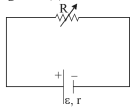
A variable resistor R, electromotive force and internal resistance $r$ are joined as shown in the given figure across the ends of the cell. Draw graph to show (i) terminal voltage and (ii) current $I$ as a function of $R$.
Image
A potential difference $V$ is applied across the ends of a conductor of length $L$ and diameter $D$. What will be the effect on drift velocity of charge carriers in the conductor when (i) V is made half (ii) L is doubled and (iii) D is made half?
In a Michelson experiment for measuring speed of light, the distance travelled by light between two reflections from the rotating mirror is 4.8km. The rotating mirror has a shape of a regular octagon. At what minimum angular speed of the mirror (other than zero) the image is formed at the position where a non-rotating mirror forms it?
A convex lens made of a material of refractive index $n_1$ is kept in a medium of refractive index $n_2$. Parallel rays of light are incident on the lens. Complete the path of rays of light emerging from the convex lens if: (i) $\mathrm{n}_1>\mathrm{n}_2$ (ii) $\mathrm{n}_1=\mathrm{n}_2$ (iii) $\mathrm{n}_1<\mathrm{n}_2$.
$\frac{1}{\text{f}}=\Big(\frac{\text{n}_1}{\text{n}_2}-1\Big)\Big(\frac{1}{\text{R}_2}+\frac{1}{\text{R}_2}\Big)$
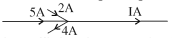
Write Kirchhoff's junction rule. Write the magnitude of current $I$ in the given figure.
Image