Question
Two long strings A and B, each having linear mass density 1.2 x 10⁻²kg/m, are stretched by different tensions 4.8N and 7.5N respectively and are kept parallel to each other with their left ends at x = 0. Wave pulses are produced on the strings at the left ends at t = 0 on string A and at t = 20ms on string B. When and where will the pulse on B overtake that on A?
Answer

$\text{m}_\text{A}=1.2\times10^{-2}\text{kg/m},\ \text{T}_\text{A}=4.8\text{N}$

$\Rightarrow\text{v}_\text{A}=\sqrt{\frac{\text{T}}{\text{m}}}=20\text{m/s}$

$\text{m}_\text{B}=1.2\times10^{-2}\text{kg/m},\ \text{T}_\text{B}=7.5\text{N}$

$\Rightarrow\text{V}_\text{B}=\sqrt{\frac{\text{T}}{\text{m}}}=25\text{m/s}$

$\text{t}=0$ in string A

$\text{t}_1=0+20\text{ms}=20\times10^{-3}=0.02\text{sec}$

In 0.02 sec A has travelled $20\times0.02=0.4\text{mt}$

Relative speed between A and B $=25-20=5\text{m/s}$

Time taken for B for overtake A $=\frac{\text{s}}{\text{v}}=\frac{0.4}{5}=0.08\text{sec}$

Need a full question paper?

Generate a complete, print-ready paper with questions like this in minutes — across 16+ boards, with answer keys.

Start Generating Free

Similar questions

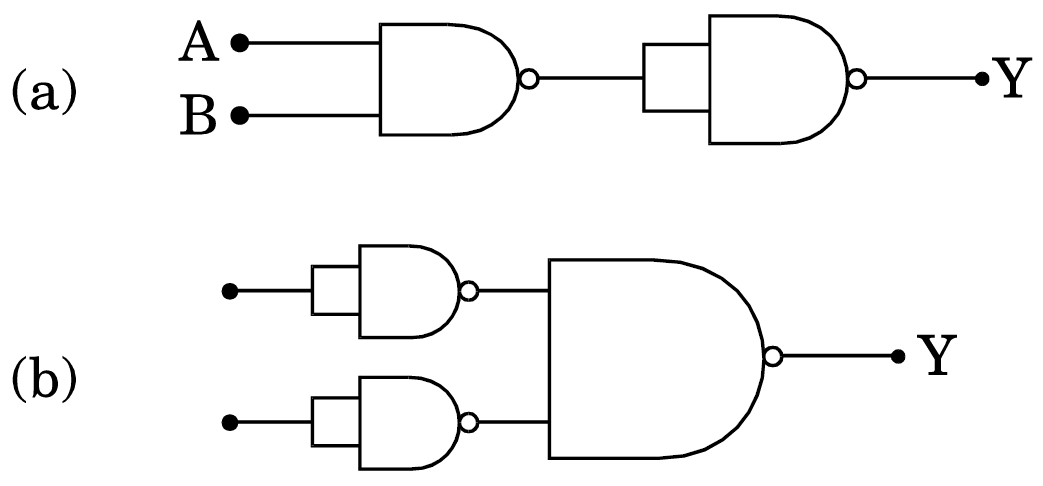
You are given two circuits (a) and (b) as shown in the figures, which consist of NAND gates. Identify the logic operation carried out by the two. Write the truth tables for each. Identify the gates equivalent to the two circuits.

What is the magnitude of magnetic force per unit length on a wire carrying a current of 8 A and making an angle of 30º with the direction of a uniform magnetic field of 0.15 T?
The nucleus $^{235}_{92}\text{Y},$ initially at rest, decays into $^{231}_{90}\text{X}$ by emitting an $\alpha-$particle
$^{235}_{92}\text{Y}\xrightarrow{ \ \ \ \ \ \ \ \ } \ ^{231}_{90}\text{X}+ \ ^4_2\text{He}+\text{energy}.$
The binding energies per nucleon of the parent nucleus, the daughter nucleus and $\alpha-$particle are 7.8MeV, 7.835MeV and 7.07MeV, respectively. Assuming the daughter nucleus to be formed in the unexcited state and neglecting its share in the energy of the reaction, find the speed of the emitted $\alpha-$particle. (Mass of $\alpha-$particle = 6.68 × 10⁻²⁷kg).
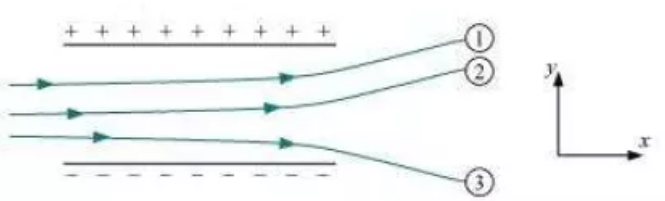
Figure 1.33 shows tracks of three charged particles in a uniform electrostatic field. Give the signs of the three charges. Which particle has the highest charge to mass ratio?

Two wires A and B of the same material and having same length, have their cross sectional areas in the ratio 1 : 6. What would be the ratio of heat produced in these wires when same voltage is applied across each?
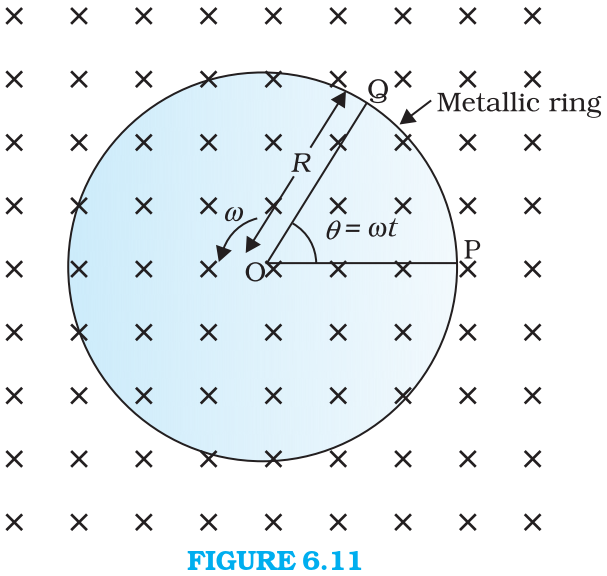
A metallic rod of $1 m$ length is rotated with a frequency of $50 rev / s$, with one end hinged at the centre and the other end at the circumference of a circular metallic ring of radius $1 m$, about an axis passing through the centre and perpendicular to the plane of the ring (Fig. 6.11). A constant and uniform magnetic field of $1 T$ parallel to the axis is present everywhere. What is the emf between the centre and the metallic ring?
Image
Using lens maker's formula obtain the equation of lens.
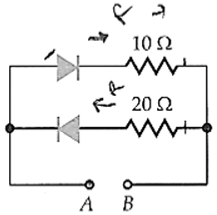
A battery of V may be connected across points A and B, as shown in the figure. Find the current drawn from the battery if the positive terminal is connected to
i. the point A and
ii. the point B
Assume that the resistance of each diode is zero in forward bias and infinity in reverse bias. 
Image
The electric current in an X-ray tube (from the target to the filament) operating at 40kV is 10mA. Assume that on an average, 1% of the total kinetic energy of the electron hitting hte target are converted into X-rays.
  1. What is the total power emitted as X-rays
  2. How much heat is produced in the target every second?
A charge of +2.0 × 10⁻⁸C is placed on the positive plate and a charge of -1.0 × 10⁻⁸C on the negative plate of a parallel-plate capacitor of capacitance $1.2\times10^{-3}\mu\text{F}.$ Calculate the potential difference developed between the plates.