MCQ
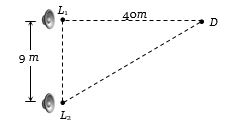
Two loudspeakers $L_1$ and $L_2$ driven by a common oscillator and amplifier, are arranged as shown. The frequency of the oscillator is gradually increased from zero and the detector at $D$ records a series of maxima and minima. If the speed of sound is $330\,ms^{-1}$ then the frequency at which the first maximum is observed is .... $Hz$
  • A
    $165 $
  • $330$
  • C
    $496 $
  • D
    $660$

Answer

Correct option: B.
$330$
b
(b) Path difference between the wave reaching at $D$
$\Delta x = {L_2}P - {L_1}P  = \sqrt {{{40}^2} + {9^2}} - 40  = 41 - 40 = 1m$
For maximum $\Delta x = (2n)\frac{\lambda }{2}$
For first maximum $(n = 1)$ ==>$1 = 2(1)\frac{\lambda }{2}$==> $\lambda = 1m$
==> $n = \frac{v}{\lambda } = 330\,Hz$.

Need a full question paper?

Generate a complete, print-ready paper with questions like this in minutes — across 16+ boards, with answer keys.

Start Generating Free

Similar questions

The dimensional formula for Boltzmann's constant is
If $\theta$ is angle between the velocity and acceleration of a particle moving on a circular path with decreasing speed, then .........
A particle is performing simple harmonic motion
$(i)$ its velocity-displacement graph is parabolic in nature
$(ii)$ its velocity-time graph is sinusoidal in nature
$(iii)$ its velocity-acceleration graph is elliptical in nature
Correct answer is
A closed organ pipe has a frequency $'n'$. If its length is doubled and radius is halved, its  frequency nearly becomes-
Electromagnets are made of soft iron because soft iron has:
Which of the accompanying $PV$, diagrams best represents an isothermal process
A ball is thrown from the location $\left(x_0, y_0\right)=(0,0)$ of a horizontal playground with an initial speed $v_0$ at an angle $\theta_0$ from the $+x$-direction. The ball is to be hit by a stone, which is thrown at the same time from the location $\left(x_1, y_1\right)=(L, 0)$. The stone is thrown at an angle $\left(180-\theta_1\right)$ from the $+x$-direction with a suitable initial speed. For a fixed $v_0$, when $\left(\theta_0, \theta_1\right)=\left(45^{\circ}, 45^{\circ}\right)$, the stone hits the ball after time $T_1$, and when $\left(\theta_0, \theta_1\right)=\left(60^{\circ}, 30^{\circ}\right)$, it hits the ball after time $T_2$. In such a case, $\left(T_1 / T_2\right)^2$ is. . . . .
Air (density $\rho$ ) is being blown on a soap film (surface tension $T$ ) by a pipe of radius $R$ with its opening right next to the film. The film is deformed and a bubble detaches from the film when the shape of the deformed surface is a hemisphere. Given that the dynamic pressure on the film due to the air blown at speed $v$ is $\frac{1}{2} \rho v^{2}$, the speed at which the bubble formed is
If a block moving up an inclined plane at $30^{\circ}$ with a velocity of $5 \,m / s$, stops after $0.5 s$, then coefficient of friction will be nearly
At constant pressure, the volume of the gas is proportional to the absolute temperature is called as: