Two loudspeakers $M$ and $N$ are located $20 \mathrm{~m}$ apart and emit sound at frequencies $118 \mathrm{~Hz}$ and $121 \mathrm{~Hz}$, respectively. $A$ car is initially at a point $P, 1800 \mathrm{~m}$ away from the midpoint $Q$ of the line $M N$ and moves towards $Q$ constantly at $60 \mathrm{~km} / \mathrm{hr}$ along the perpendicular bisector of $M N$. It crosses $Q$ and eventually reaches a point $R, 1800(m$ away from $Q$. Let $v(t)$ represent the beat frequency measured by a person sitting in tlie car at time $t$. Let $v_P, v_Q$ and $v_R$ be the beat frequencies measured at locations $P . Q$ and $R$, respectively. The speed of sound in air is $330 \mathrm{~m} \mathrm{~s}^{-1}$. Which of the following statement($s$) is(are) true regarding the sound heard by the person?
($A$) $v_P+v_R=2 v_Q$
($B$) The rate of change in beat frequency is maximum when the car passes through $Q$
($C$) The plot below represents schematically the variation of beat frequency with time
(image)
($D$) The plot below represents schematically the variation of beat frequency with time
(image)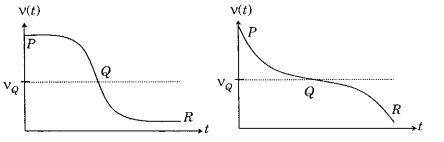
IIT 2016, Advanced
Download our app for free and get started
Frequency of $M$ received by car
$f _1=118\left(\frac{V+V_0 \cos \theta}{V}\right)$
$f _2=121\left(\frac{V+V_0 \cos \theta}{V}\right)$
$Image$
No. of beats $n=\Delta f=f_2-f_1$
$n=3\left(\frac{V+V_0 \cos \theta}{V}\right)$
$n=3\left(1+\frac{V_0}{V} \cos \theta\right)$
As $\theta \uparrow, \cos \theta \downarrow, n \perp$
Rate of change of beat frequency
$\frac{d n}{d \theta}=3\left[\frac{V_0}{V}(-\sin \theta)\right]$
$\frac{d n}{d \theta}$ is maximum when $\sin \theta=1 ; \theta=90^{\circ}$ $i.e.$ car is at point $Q$ .
$v_p=3\left(1+\frac{v_0}{V} \cos \theta\right)$
$v_R=3\left(1-\frac{v_0}{V} \cos \theta\right)$
At $Q$
No. of beats $v_Q=121-118=3$
$v_Q=\frac{v_P+v_R}{2}$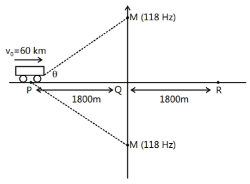

Download our appand get started for free
Experience the future of education. Simply download our apps or reach out to us for more information. Let's shape the future of learning together!No signup needed.*
Similar Questions
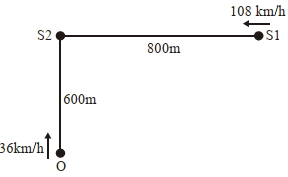
- 1A train $S1$, moving with a uniform velocity of $108 km / h$, approaches another train $S 2$ standing on a platform. An observer $O$ moves with a uniform velocity of $36 km / h$ towards $S 2$, as shown in figure. Both the trains are blowing whistles of same frequency $120 Hz$. When $O$ is $600 m$ away from $S 2$ and distance between $S 1$ and $S 2$ is $800 m$, the number of beats heard by $O$ is. . . . . [Speed of the sound $=330 m / s$ ]View Solution
- 2The displacement $y$ of a wave travelling in the x-direction is given by $y = {10^{ - 4}}\sin \,\,\left( {600t - 2x + \frac{\pi }{3}} \right)$ metres, where $x$ is expressed in metres and $t$ in seconds. The speed of the wave-motion, in ..... $ms^{-1}$, isView Solution
- 3$Assertion :$ When a beetle moves along the sand within a few tens of centimeters of a sand scorpion, the scorpion immediately turns towards the beetle and dashes towards itView Solution
$Reason :$ When a beetle disturbs the sand, it sends pulses along the sand's surface. One set of pulses is longitudinal while the other set is transverse. - 4The velocity of sound in a gas at pressure $P$ and density $d$ isView Solution
- 5View SolutionIn a standing wave, all particles of the medium cross the mean position with
- 6View SolutionIn a simple harmonic wave, minimum distance between particles in same phase always having same speed, is ..........
- 7A steel wire with mass per unit length $7.0 \times 10^{-3}\,kg\,m ^{-1}$ is under tension of $70\,N$. The speed of transverse waves in the wire will be $.........m/s$View Solution
- 8The equation of a progressive wave is $y = a\,\sin \,\left( {\frac{\pi }{2}x - 200\pi t} \right)$ . The frequency of the wave will be .... $Hz$View Solution
- 9An iron block is dropped into a deep well. Sound of splash is heard after $4.23 \,s$. If the depth of the well is $78.4 \,m$, then find the speed of sound in air is ............ $m / s$ $\left(g=9.8 \,m / s ^2\right)$View Solution
- 10The percentage increase in the speed of transverse waves produced in a stretched string if the tension is increased by $4\, \%$, will be ......... $\%$View Solution