Question
Two magnetic lines of force:

Answer

  1. Never cut each other.
Explanation:
A magnetic field line is that path in space that points in the direction of the magnetic field at every point along it. Walk along a magnetic field line carrying a compass, and the needle will always point in the direction you need to go in order to stay on that magnetic field line (the needle has to be able to pivot up and down as well as around in a circle like most compasses).
If two field lines crossed, then that is resembling that the magnetic field points in two different directions, at one place. There is only one direction to the magnetic field at any place at any time, so this doesn't happen.

Need a full question paper?

Generate a complete, print-ready paper with questions like this in minutes — across 16+ boards, with answer keys.
Start Generating Free

Similar questions

What type of lens from the following would you have in your magnifying lens to read a page in small print?
A motor having an armature of resistance 2Ω is designed to operate at 220 V mains. At full speed, it develops a back e.m.f. of 210V. When the motor is running at full speed, the current in the armature is(a) 5A      (b) 105A(c) 110A  (d) 215A
       
A point object is placed at a distance of 30 cm from a convex mirror of focal length 30cm. The image will form at(a) Infinity(b) Focus(c) Pole(d) 15 cm behind the mirror
   
   
A sphere of radius $R$ has a uniform distribution of electric charge in its volume. At a distance $x$ from its centre, for $x < R,$ the electric field is directly proportional to
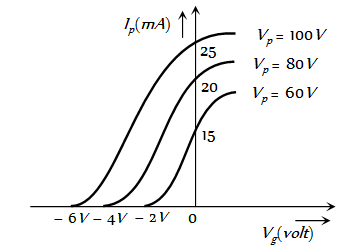
The variation of anode current in a triode corresponding to a change in grid potential at three different values of the plate potential is shown in the diagram. The mutual conductance of the triode is
The resistance of a wire is 20 ohms. It is so stretched that the length becomes three times, then the new resistance of the wire will be(a) 6.67 ohms(b) 60.0 ohms(c) 120 ohms(d) 180.0 ohms
       
Two voltameters, one of copper and another of silver, are joined in parallel. When a total charge $q$ flows through the voltameters, equal amount of metals are deposited. If the electrochemical equivalents of copper and silver are $\mathrm{z}_1$ and $\mathrm{z}_2$ respectively the charge which flows through the silver voltameter is
The main defect of Bohr's atom model is :
In comparison to a half wave rectifier, the full wave rectifier gives lower(a) Efficiency(b) Average dc(c) Average output voltage(d) None of these
   
   
According to Lenz's law there is conversion of: