MCQ
Two magnetic lines of force:
  • Never cut each other.
  • B
    Cut near the poles.
  • C
    Cut according to the position of the magnet.
  • D
    Cut at neutral points.

Answer

Correct option: A.
Never cut each other.
A magnetic field line is that path in space that points in the direction of the magnetic field at every point along it. Walk along a magnetic field line carrying a compass, and the needle will always point in the direction you need to go in order to stay on that magnetic field line $($the needle has to be able to pivot up and down as well as around in a circle like most compasses$).$
If two field lines crossed, then that is resembling that the magnetic field points in two different directions, at one place. There is only one direction to the magnetic field at any place at any time, so this doesn't happen.

Need a full question paper?

Generate a complete, print-ready paper with questions like this in minutes — across 16+ boards, with answer keys.
Start Generating Free

Similar questions

In a Young's double slit experiment, the source illuminating the slits is changed from blue to violet. The width of the fringes
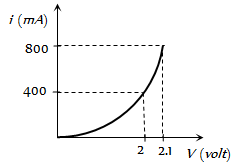
The i-V characteristic of a P-N junction diode is shown below. The approximate dynamic resistance of the P-N junction when a forward bias of 2volt is applied
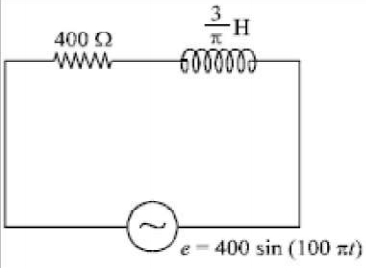
A resistance of $400\,\Omega$ is connected in series with an inductor of $(3 / \pi)$ $H$ and this combination is connected across an $A.C.$ source as shown in figure.
A plane electromagnetic wave of frequency $100\, MHz$ is travelling in vacuum along the $x -$ direction. At a particular point in space and time, $\overrightarrow{ B }=2.0 \times 10^{-8} \hat{ k } T$. (where, $\hat{ k }$ is unit vector along $z-$direction) What is $\overrightarrow{ E }$ at this point ?
In a potentiometer experiment two cells of e.m.f. $E_1$ and $E_2$ are used in series and in conjunction and the balancing length is found to be 58 cm of the wire. If the polarity of $E_2$ is reversed, then the balancing length becomes 29 cm. The ratio $\frac{E_1}{E_2}$ of the e.m.f. of the two cells is
A beam of parallel rays is brought to a focus by a plano-convex lens. A thin concave lens of the same focal length is joined to the first lens. The effect of this is
A small current element of length $d \ell$ and carrying current is placed at $(1,1,0)$ and is carrying current in ' $+ z$ ' direction. If magnetic field at origin be $\overrightarrow{ B }_1$ and at point $(2,2,0)$ be $\overrightarrow{ B }_2$ then
Relative permeability of iron is $5500,$  then its magnetic susceptibility will be
When a proton is accelerated through $1\,V$, then its kinetic energy will be.....$eV$
Assertion : A paramagnetic sample display greater magnetisation (for the same magnetising field) when cooled.
Reason : The magnetisation does not depend on temperature.