MCQ
Two masses $8\; kg$ and $12\; kg$ are connected at the two ends of a light inextensible string that goes over a frictionless pulley. Find the acceleration of the masses, and the tension in the string when the masses are released.
  • A
    $2 \;m / s ^{2}\;and\;72\;N$
  • B
    $3 \;m / s ^{2}\;and\;108\;N$
  • C
    $4 \;m / s ^{2}\;and\;96\;N$
  • $2 \;m / s ^{2}\;and\;96\;N$

Answer

Correct option: D.
$2 \;m / s ^{2}\;and\;96\;N$
d
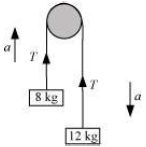
The given system of two masses and a pulley can be represented as shown in the following figure:

Smaller mass, $m_{1}=8 \,kg$

Larger mass, $m_{2}=12\, kg$

Tension in the string $=T$

Mass $m_{2},$ owing to its weight, moves downward with acceleration $a,$ and mass $m_{1}$ moves upward.

Applying Newton's second law of motion to the system of each mass:

For mass $m_{\underline{1}}:$ The equation of motion can be written as:

$T-m_{1} g =m a$

For mass $m_{2}$ : The equation of motion can be written as:

$m_{2} g -T=m_{2} a$

Adding above equations , we get:

$\left(m_{2}-m_{1}\right) g =\left(m_{1}+m_{2}\right) a$

$\therefore a=\left(\frac{m_{2}-m_{1}}{m_{1}+m_{2}}\right) g$

$=\left(\frac{12-8}{12+8}\right) \times 10=\frac{4}{20} \times 10=2 m / s ^{2}$

Therefore, the acceleration of the masses is $2 \;m / s ^{2}$

Substituting the value of $a$ in equation ( $i i$ ), we get:

$m_{2} g -T=m_{2}\left(\frac{m_{2}-m_{1}}{m_{1}+m_{2}}\right) g$

$T=\left(m_{2}-\frac{m_{2}^{2}-m_{1} m_{2}}{m_{1}+m_{2}}\right) g$

$=\left(\frac{2 m_{1} m_{2}}{m_{1}+m_{2}}\right) g$

$=\left(\frac{2 \times 12 \times 8}{12+8}\right) \times 10$

$=\frac{2 \times 12 \times 8}{20} \times 10=96\, N$

Therefore, the tension in the string is $96\, N$.
Need a full question paper?

Generate a complete, print-ready paper with questions like this in minutes — across 16+ boards, with answer keys.

Start Generating Free

Similar questions

$Assertion$: In the measurement of physical quantities direct and indirect methods are used.

$Reason$ : The accuracy and precision of measuring instruments along with errors in measurements should be taken into account, while expressing the result.

The bulk modulus of copper is $1.4 × 10^{11}$ $Pa$ and the coefficient of linear expansion is $1.7 × 10^{-5} (C^o )^{-1}$. What hydrostatic pressure is necessary to prevent a copper block from expanding when its temperature is increased from $20^o C$ to $30^o C$
The center of mass is the point around which there is zero for the system.
A gas has volume $V$ and pressure $P$. The total translational kinetic energy of all the molecules of the gas is
In a mixture of gases at a fixed temperature:
At constant volume the specific heat of a gas is $\frac{{3R}}{2}$, then the value of $'\gamma '$ will be .... 
A container contains hot water at ${100^o}C$. If in time ${T_1}$ temperature falls to ${80^o}C$ and in time ${T_2}$ temperature falls to ${60^o}C$ from ${80^o}C$, then
A body of mass $m$ is placed on the earth’s surface. It is taken from the earth’s surface to a height $h = 3R$. The change in gravitational potential energy of the body is
The equation of motion of a particle of mass $1\,g$ is $\frac{{{d^2}x}}{{d{t^2}}} + {\pi ^2}x = 0$ where $x$ is displacement (in $m$ ) from mean position. The frequency of oscillation is .... $s$ (in $Hz$ )
 The $x-t$ graph of a particle moving along a straight line is shown in figure The $v-t$ graph of the particle is correctly shown by