Two masses ${m_1}$ and ${m_2}$ are suspended together by a massless spring of constant k. When the masses are in equilibrium, ${m_1}$ is removed without disturbing the system. Then the angular frequency of oscillation of ${m_2}$ is
Easy
Download our app for free and get started
(b)$\omega = \sqrt {\frac{k}{m}} $

Download our appand get started for free
Experience the future of education. Simply download our apps or reach out to us for more information. Let's shape the future of learning together!No signup needed.*
Similar Questions
- 1Two pendulums differ in lengths by $22\,cm$ . They oscillate at the same place such that one of them makes $15\,oscillations$ and the other makes $18\,oscillations$ during the same time. The lengths (in $cm$ ) of the pendulums areView Solution
- 2The time period of a particle executing $S.H.M.$ is $8 \,s$. At $t=0$ it is at the mean position. The ratio of distance covered by the particle in $1^{\text {st }}$ second to the $2^{\text {nd }}$ second is .............. $s$View Solution
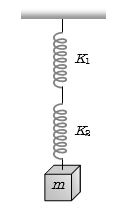
- 3View SolutionThe frequency of oscillation of the springs shown in the figure will be
- 4A particle performing $SHM$ is found at its equilibrium at $t = 1\,sec$. and it is found to have a speed of $0.25\,m/s$ at $t = 2\,sec$. If the period of oscillation is $6\,sec$. Calculate amplitude of oscillationView Solution
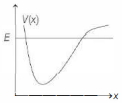
- 5Consider a one-dimensional potential $V(x)$ as shown in the figure below. A classical particle of mass $m$ moves under its influence and has total energy $E$ as shown below. The motion isView Solution
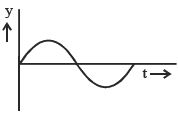
- 6The displacement versus time graph of $SHM$ is Which of the following is its acceleration versus time graph ?View Solution
- 7The energy of a particle executing simple harmonic motion is given by $E = Ax^2 + Bv^2$, where $x$ is the displacement from mean position $x = 0$ and $v$ is the velocity of the particle at $x$ then choose the incorrect statementView Solution
- 8A mass $M$ is suspended from a spring of negligible mass. The spring is pulled a little and then released so that the mass executes simple harmonic oscillations with a time period $T$. If the mass is increased by m then the time period becomes $\left( {\frac{5}{4}T} \right)$. The ratio of $\frac{m}{{M}}$ isView Solution
- 9A body oscillates with a simple harmonic motion having amplitude $0.05\, m .$ At a certain instant, its displacement is $0.01\, m$ and acceleration is $1.0 \,m / s ^{2} .$ The period of oscillation isView Solution
- 10A particle of mass $10\, gm$ is describing $S.H.M.$ along a straight line with period of $2\, sec$ and amplitude of $10, cm$. Its kinetic energy when it is at $5 \,cm$ from its equilibrium position isView Solution