MCQ
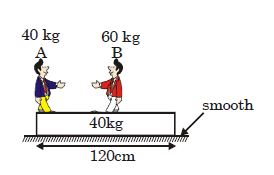
Two men $‘A’$ and $‘B’$ are standing on a plank. $‘B’$ is at the middle of the plank and $‘A’$ is at the left end of the plank. System is initially at rest and masses are as shown in figure. $‘A’$ and $‘B’$ starts moving such that the position of $‘B’$ remains fixed with respect to ground till $‘A’$ meets $‘B’$ . Then the point where $A$ meets $B$ is located at 
  • A
    The middle of the plank
  • B
    $30\ cm$ from the left end of the plank
  • The right end of the plank
  • D
    None of these

Answer

Correct option: C.
The right end of the plank
c
$0$ = $40 S_A$ + $40S_P$
$S_A$ = $-S_P$ = $60\ cm$
$S_P$ = $-60\ cm$

Need a full question paper?

Generate a complete, print-ready paper with questions like this in minutes — across 16+ boards, with answer keys.

Start Generating Free

Similar questions

Vapour is injected at a uniform rate in a closed veseel which was initially evacuated. The pressure in the vessel:
In the resonance tube experiment, first resonant length is $l_1$ and second  resonant length is $l_2$ then the third resonant length will be
The metallic bob of simple pendulum has the relative density $5$. The time period of this pendulum is $10\,s$. If the metallic bob is immersed in water, then the new time period becomes $5 \sqrt{ x } s$. The value of $x$ will be.
A standing wave pattern of amplitude $A$ in a string of length $L$ shows $2$ nodes (plus those at two ends). If one end of the string corresponds to the origin and $v$ is the speed of progressive wave, the disturbance in the string, could be represented (with appropriate phase) as: 
A mercury drop of $1\, cm$ radius is broken into ${10^6}$ small drops. The energy used will be (surface tension of mercury is $35 \times {10^{ - 3}}N/cm)$
Match the columns

  Column $-I$
    $R/H_{max}$
  Column $-II$
  Angle of projection $\theta $
   $A.$ $1$    $1.$ ${60^o}$
   $B.$ $4$    $2.$ ${30^o}$
   $C.$ $4\sqrt 3$    $3.$ ${45^o}$
   $D.$ $\frac {4}{\sqrt 3}$    $4.$ $tan^{-1}\,4\,=\,{76^o}$


Two planets have the same average density but their radii are ${R_1}$ and ${R_2}$. If acceleration due to gravity on these planets be ${g_1}$ and ${g_2}$ respectively, then
In isothermic process, which statement is wrong
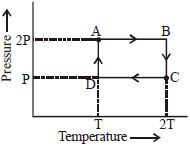
An ideal monoatomic gas is taken through the thermodynamic states $A \to B \to C \to D$ via the paths shown in the figure. If $U_A, U_B, U_C$ and $U_D$ represent the internal energy of the gas in state $A, B\, C$ and $D$ respectively, then which of the following is not true?
The value of coefficient of volume expansion of glycerin is $5 \times 10^{-4} K^{-1}$. The fractional change in the density of glycerin for a rise of $40^{\circ} C$ in its temperature, is