MCQ
Two metal rods $1$ and $2$ of same lengths have same temperature difference between their ends. Their thermal conductivities are $K_1$ and $K_2$ and cross sectional areas $A_1$ and $A_2$ , respectively. If the rate of heat conduction in $1$ is four times that in $2$, then
  • A
    $k_1\,\,A_2=4k_2\,\,A_1$
  • $k_1\,\,A_1=4k_2\,\,A_2$
  • C
    $k_1=4k_2$
  • D
    $k_1\,\,A_1^2=4k_2\,\,A_2^2$

Answer

Correct option: B.
$k_1\,\,A_1=4k_2\,\,A_2$
b
Let $L$ be length of each rod.

Rate of heat flow in rod $1$ for the temperature difference $\Delta T$ is

${H_1} = \frac{{{K_1}{A_1}\Delta T}}{L}$

Rate of heat flow in rod $2$ for the same difference $\Delta T$ is

${H_2} = \frac{{{K_2}{A_2}\Delta T}}{L}$

As per question, ${H_1} = 4{H_2}$

$\frac{{{K_1}{A_1}\Delta T}}{L} = 4\frac{{{K_2}{A_2}\Delta T}}{L}\,\,;\,\,{K_1}{A_1} = 4{K_2}{A_2}$

Need a full question paper?

Generate a complete, print-ready paper with questions like this in minutes — across 16+ boards, with answer keys.

Start Generating Free

Similar questions

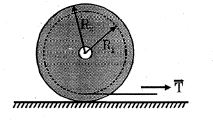
A spool consists a cylinder of radius $R_1$ wraped with thread and its end caps have radius $R_2$ as shown in the end view illustrated in figure. The mass of the spool, including the thread, is $m$ , and its moment of inertia about an axis through its center is $I$ . The spool is placed on a rough horizontal surface so that it rolls without  slipping. When a force $\vec T$ acting to the right is applied to the free end of the thread. Friction force exerted by the surface on the spool is given by 
The scale on a steel metre stick is calibrated at $20^o\,C$.The error in the reading of $50\,cm$ at $30^o\,C$ is: (take linear expansion coefficient of steel $= 1.0 \times 10^{-5} /  ^oC)$
A person running horizontally observes that rain is falling on his head vertically with speed $10\,m/s$. He stops and observes that rain is coming at an angle $30^o$ with vertical. Find the speed of rain w.r.t. ground
If the metal bob of a simple pendulum is replaced by a wooden bob, then its time period will
Match the thermodynamic processes taking place in a system with the correct conditions. In the table: $\Delta Q$ is the heat supplied, $\Delta W$ is the work done and $\Delta U$ is change in internal energy of the system
Process Condition
$(I)$ Adiabatic $(A)\; \Delta W =0$
$(II)$ Isothermal $(B)\; \Delta Q=0$
$(III)$ Isochoric $(C)\; \Delta U \neq 0, \Delta W \neq 0 \Delta Q \neq 0$
$(IV)$ Isobaric $(D)\; \Delta U =0$
Two stones are thrown up simultaneously with initial speeds of ' $u_1$ and $u_2\left(u_2 > u_1\right)$. They hit the ground after $6\,s$ and $10\,s$ respectively. Which graph in figure correctly represents the time variation of $\Delta x=\left(x_2-x_1\right)$, the relative position of the second stone with respect to the first upto $t=10\,s$ ? Assume that the stones do not rebound after hitting the ground.
An ideal heat engine exhausting heat at $77\,^oC$. To have a $30\%$ efficiency. It must take heat at...... $^oC$
An open glass tube is immersed in mercury in such a way that a length of $8\ cm$ extends above the mercury level. The open end of the tube is then closed and sealed and the tube is raised vertically up by additional $46\ cm$. What will be length of the air column above mercury in the tube now ....... $cm$ ?

( Atmospheric pressure = $76\ cm$ of $Hg$)

Given that $\overrightarrow A + \overrightarrow B + \overrightarrow C= 0$ out of three vectors two are equal in magnitude and the magnitude of third vector is $\sqrt 2 $ times that of either of the two having equal magnitude. Then the angles between vectors are given by
The ratio of kinetic energy of a planet at perigee and apogee during its motion around the sun in elliptical orbit of eccentricity $e$ is ..........