MCQ
Two metal strips that constitute a thermostat must necessarily differ in their
  • A
    Mass
  • B
    Length
  • C
    Resistivity
  • Coefficient of linear expansion

Answer

Correct option: D.
Coefficient of linear expansion
d
(d) Thermostat is used in electric apparatus like refrigerator, Iron etc for automatic cut off.

Therefore for metallic strips to bend on heating their coefficient of linear expansion should be different.

Need a full question paper?

Generate a complete, print-ready paper with questions like this in minutes — across 16+ boards, with answer keys.
Start Generating Free

Similar questions

A TV tower has a height of 100 m. The average population density around the tower is 1000 per $km^2$. The radius of the earth is $6.4 \times {10^6}$m. the population covered by the tower is
When the velocity of body is variable, then
In the non-resonant circuit, what will be the nature of the circuit for frequencies higher than the resonant frequency
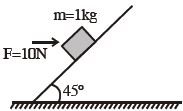
A body of mass $1\, kg$ lies on smooth inclined plane. The body is given force $F = 10N$  horizontally as shown. The magnitude of net normal reaction on the body is 
Particle $A$ is moving along $x$-axis. At time $t=0$, it has velocity of $10\,m / s$ and acceleration $-4\,m / s ^2$. Particle $B$ has velocity of $20\,m / s$ and acceleration $-2\,m / s ^2$. Initially, both the particles are at origin. At time $t=2\,s$, distance between the two particles is $.............\,m$
A substance of mass $m\, kg$ requires a power input of $P$ watts to remain in the molten state at its melting point. When the power is turned off, the sample completely solidifies in time $t$ sec. What is the latent heat of fusion of the substance
In a series $L-C$ circuit, if $L=10^{-3} \,H$ and $C=3 \times 10^{-7} \,F$ is connected to a $100 \,V -50 \,Hz$ a.c. source, the impedance of the circuit is ...........
The electric field at $20 \,cm$ from the centre of a uniformly charged non-conducting sphere of radius $10 \,cm$ is $E$. Then at a distance $5 \,cm$ from the centre it will be
Atomic mass number of an element thorium is $232$ and its atomic number is $90$. The end product of this radioactive element is an isotope of lead (atomic mass $208$ and atomic number $82$). The number of alpha and beta particles emitted is
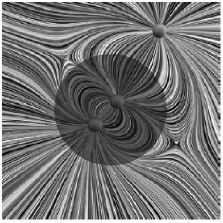
The figure shows the electric field lines of three charges with charge $+1, +1$, and $-1$. The Gaussian surface in the figure is a sphere containing two of the charges. The total electric flux through the spherical Gaussian surface is