MCQ
Two mutually perpendicular simple harmonic vibrations have same amplitude, frequency and phase. When they superimpose, the resultant form of vibration will be
  • A
    A circle
  • B
    An ellipse
  • A straight line
  • D
    A parabola

Answer

Correct option: C.
A straight line
c
(c) If ${y_1} = {a_1}\sin \omega \,t$ and ${y_2} = {a_2}\sin (\omega \,t + 0) = {a_2}\sin \omega \,t$
==> $\frac{{y_1^2}}{{a_1^2}} + \frac{{y_2^2}}{{a_2^2}} - \frac{{2{y_1}{y_2}}}{{{a_1}{a_2}}} = 0$

==> ${y_2} = \frac{{{a_2}}}{{{a_1}}}{y_1}$
This is the equation of straight line.

Need a full question paper?

Generate a complete, print-ready paper with questions like this in minutes — across 16+ boards, with answer keys.
Start Generating Free

Similar questions

A curve between magnetic moment and temperature of magnet is
Where will it be profitable to purchase $1$ kilogram sugar
$A$ straight rod of length $L$ is released on a frictionless horizontal floor in a vertical position. As it falls $+$ slips, the distance of a point on the rod from the lower end, which follows a quarter circular locus is
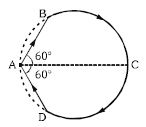
Consider a circle of radius $42\  cm$. An insect crawls with uniform speed of $1.3\  cm/s$ along the chord $AB$ then along the circular arc $BCD$ to reach point $D$ and then following cord $DA$ to reach finally $A$. Time spend by the insect to crawl from $A$ to $A$ is closest to    ......... $\sec$
For previous objective, which of the following graphs is correct
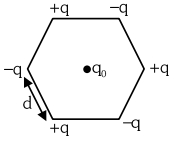
Six charges $+ q ,- q ,+ q ,- q ,+ q$ and $- q$ are fixed at the corners of a hexagon of side $d$ as shown in the figure. The work done in bringing a charge $q _0$ to the centre of the hexagon from infinity is :$\left(\varepsilon_0-\right.$ permittivity of free space)
In a Young's double slit experiment, light from a laser source falls on a pair of very narrow slits separated by $1.0 \,\mu m$ and bright fringes separated by $1.0 \,mm$ are observed on a distant screen. If the frequency of the laser light is doubled, the separation of the bright fringes is .......$\,mm$ ?
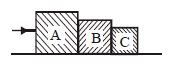
Three blocks, $A, B$ and $C,$ of masses $4\,kg, 2\,kg$ and $1\,kg$ respectively, are in contact on a frictionless surface, as shown. If a force of $14\,\,N$ is applied on the $4\,\,kg$  block, then the contact force between $A$ and $B$  is ....... $N$
In an $L C R$ circuit $L=8.0 \,henry$, $C=0.5 \,\mu F$ and $R=100 \,ohm$ are in series. The resonance angular frequency is ........ $rad / s$
Both the nucleus and the atom of some element are in their respective first excited states. They get de-excited by emitting photons of wavelengths $\lambda _N,\,\lambda _A$  respectively. The ratio $\frac{{{\lambda _N}}}{{{\lambda _A}}}$  is closest to