MCQ
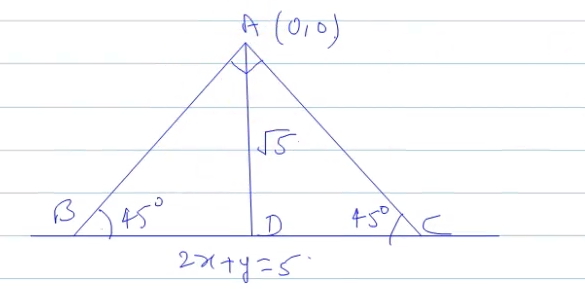
Two mutually perpendicular straight lines through the origin from an isosceles triangle with the line $2x + y = 5$ . Then the area of the triangle is :
  • $5$
  • B
    $3$
  • C
    $2.5$
  • D
    $1$

Answer

Correct option: A.
$5$
a
$A D=\left|\frac{0+0-5}{\sqrt{(2)^{2}+(1)^{2}}}\right| \Rightarrow \frac{5}{\sqrt{5}} \Rightarrow \sqrt{5}$

$In$ triangle $A B D$

$\tan 45^{\circ}=\frac{A D}{B D} \Rightarrow \frac{\sqrt{5}}{B D}=1$

$B D=\sqrt{5}$

$DC=\sqrt{5}$

$BC=2 \sqrt{5}$

Area of $\Delta A B C=\frac{1}{2} \times B C \times A D \Rightarrow \frac{1}{2} \times 2 \sqrt{5} \times \sqrt{5}$$=5$
 

Need a full question paper?

Generate a complete, print-ready paper with questions like this in minutes — across 16+ boards, with answer keys.

Start Generating Free

Similar questions

$\int_{\,0}^{\,\infty } {\,\log \left( {x + \frac{1}{x}} \right)\frac{{dx}}{{1 + {x^2}}}} $ is equal to
If $\int \sin ^{-1}\left(\sqrt{\frac{x}{1+x}}\right) d x=A(x) \tan ^{-1}(\sqrt{x})+B(x)+C$ where $C$ is a constant of integration, then the ordered pair $( A ( x ), B ( x ))$ can be
When a certain biased die is rolled, a particular face occurs with probability $\frac{1}{6}-\mathrm{x}$ and its opposite face occurs with probability $\frac{1}{6}+\mathrm{x}$. All other faces occur with probability $\frac{1}{6}$. Note that opposite faces sum to $7$ in any die. If $0\,<\,x\,<\,\frac{1}{6}$, and the probability of obtaining total $\mathrm{sum}=7$, when such a die is rolled twice, is $\frac{13}{96}$, then the value of $x$ is:
The ratio in which the $x-$ axis divides the area of the region bounded by the curves $y = x^2 - 4 x \,\, \& \,\, y = 2 x - x^2$ is :
The projection of the vector $i-2j+k$ on the  vector $4i-4j+7k$ is
If $A = \{ 1,\,2,\,3,\,4,\,5\} ,$ then the number of proper subsets of $A$ is
Let $f(x) = \,\left\{ {\begin{array}{*{20}{c}}   {\frac{{\sin \pi x}}{{5x}},}&{x \ne 0} \\    {k,}&{x = 0}  \end{array}} \right.$ if $f(x)$  is continuous at  $x = 0,$  then $k=$
The general value of $\theta $ in the equation $2\sqrt 3 \cos \theta = \tan \theta $, is
Let $A$ is a symmetric and $ \,B$ is a skew symmetric matrix, such that  $A - B = \left[ {\begin{array}{*{20}{c}}
  1&2 \\ 
  3&4 
\end{array}} \right]$, then $|A|$ is
If $z = {\tan ^{ - 1}}\left( {{x \over y}} \right)$, then ${z_x}:{z_y} = $