Question
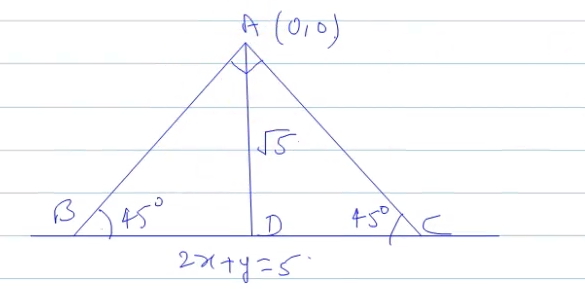
Two mutually perpendicular straight lines through the origin from an isosceles triangle with the line $2x + y = 5$ . Then the area of the triangle is :

Answer

a
$A D=\left|\frac{0+0-5}{\sqrt{(2)^{2}+(1)^{2}}}\right| \Rightarrow \frac{5}{\sqrt{5}} \Rightarrow \sqrt{5}$

$In$ triangle $A B D$

$\tan 45^{\circ}=\frac{A D}{B D} \Rightarrow \frac{\sqrt{5}}{B D}=1$

$B D=\sqrt{5}$

$DC=\sqrt{5}$

$BC=2 \sqrt{5}$

Area of $\Delta A B C=\frac{1}{2} \times B C \times A D \Rightarrow \frac{1}{2} \times 2 \sqrt{5} \times \sqrt{5}$$=5$
 

Need a full question paper?

Generate a complete, print-ready paper with questions like this in minutes — across 16+ boards, with answer keys.

Start Generating Free

Similar questions

A man tosses a coin $10$ times, scoring $1$ point for each head and $2$ points for each tail. Let $P(K)$ be the probability of scoring at least $K$ points. The largest value of $K$ such that $P(K) > \frac{1}{2}$ is
If $f (x) =$ $\frac{{\ell \,n\,\,\left( {{e^{{x^2}}}\,\, + \,\,2\,\sqrt x } \right)}}{{\sqrt x }}$ is continuous at $x = 0$ , then $f (0)$ must be equal to :
Three distinct numbers are selected randomly from the set $\{1,2,3, \ldots \ldots, 40\}$. If the probability, that the selected numbers are in an increasing G.P. is $\frac{ m }{ n }$, $\operatorname{gcd}( m , n )=1$, then $m + n$ is equal to __________.
$PQ$ is any focal chord of the parabola $y^2=32x.$ The length of $PQ$ can never be less than : ............ $\mathrm{unit}$
For a real number $x$, let $[x]$ denote the largest integer less than or equal to $x$ and $\{x\}=x-[x]$. The smallest possible integer value of $n$ for which $\int_1^n[x]\{x\} d x$ exceeds $2013$ is
The number of integers, between $100$ and $1000$ having the sum of their digits equals to $14$ , is $.....$
Let $\alpha > 0$, be the smallest number such that the expansion of $\left(x^{\frac{2}{3}}+\frac{2}{x^3}\right)^{30}$ has a term $\beta x^{-\alpha}, \beta \in N$. Then $\alpha$ is equal to $.............$.
If $x{e^{xy}} = y + {\sin ^2}x$, then at $x = 0,{{dy} \over {dx}} = $
Let $\lambda^{*}$ be the largest value of $\lambda$ for which the function $f _{\lambda}( x )=4 \lambda x ^{3}-36 \lambda x ^{2}+36 x +48$ is increasing for all $x \in R$. Then $f _{\lambda} *(1)+ f _{\lambda} *(-1)$ is equal to 
Let $P=\{z \in \mathbb{C}:|z+2-3 i| \leq 1\}$ and $Q=\{z \in \mathbb{C}: z(1+i)+\bar{z}(1-i) \leq-8\}$. Let in $\mathrm{P} \cap \mathrm{Q},|\mathrm{z}-3+2 \mathrm{i}|$ be maximum and minimum at $z_1$ and $z_2$ respectively. If $\left|z_1\right|^2+2|z|^2=\alpha+\beta \sqrt{2}$, where $\alpha, \beta$ are integers, then $\alpha+\beta$ equals______.