Question
Two nearby objects are just resolved, if the principle maximum in the diffraction pattern of one coincides with:

Answer

  1. First minimum of the other
Explanation:
The Rayleigh criterion is the generally accepted criterion for the minimum resolvable detail - the imaging process is said to be diffraction-limited when the first diffraction minimum of the image of one source point coincides with the maximum of another.

Need a full question paper?

Generate a complete, print-ready paper with questions like this in minutes — across 16+ boards, with answer keys.
Start Generating Free

Similar questions

Suppose the medium in the previous question is water. Select the correct option$(s)$ from the list given in that question.
For a colour of light the wavelength for air is $6000 \mathring A$ and in water the wavelength is $4500 \mathring A .$ Then the speed of light in water will be
Cyclotron is used to accelerate:
A plane electromagnetic wave is incident on a material surface. If the wave delivers momentum p and energy E, then (a) p = 0, E = 0(b) p ¹ 0, E ¹ 0(c) p ¹ 0, E = 0(d) p = 0, E ¹ 0
       
A student wants to find if a star if moving away from the earth or towards the earth. Which of the following principle he can use? 
A. Current flow inside the capacitor due to accumulation of charges on the capacitor walls is called displacement current.
B. Current due to the flow of electrons due to some potential difference is called as conduction current. 
C. Displacement current came into existence when Maxwell observed that if a magnetic compass is placed between the capacitors the needle gets deflected which signifies presence of magnetic fields which would possibly caused due to some changing current.
D. Displacement current change the actual motion of electric charges.
Which of the above statement(s) is/ are correct?
The energy gap in case of which of the following is less than 3eV?
In a hydrogen atom, which of the following electronic transitions would involve the maximum energy change:
Identify the correct statement from below:
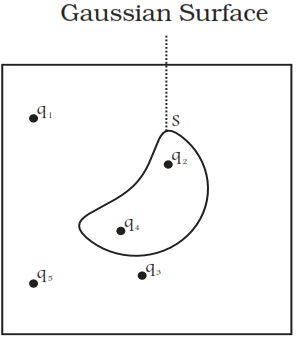
Five charges $q_1, q_2, q_3, q_4,$ and $q_5$ are fixed at their positions as shown in. $S$ is a Gaussian surface. The Gauss’s law is given by$\oint\limits_\text{S}\text{E.ds}=\frac{\text{q}}{\epsilon_0}$ Which of the following statements is correct?