MCQ
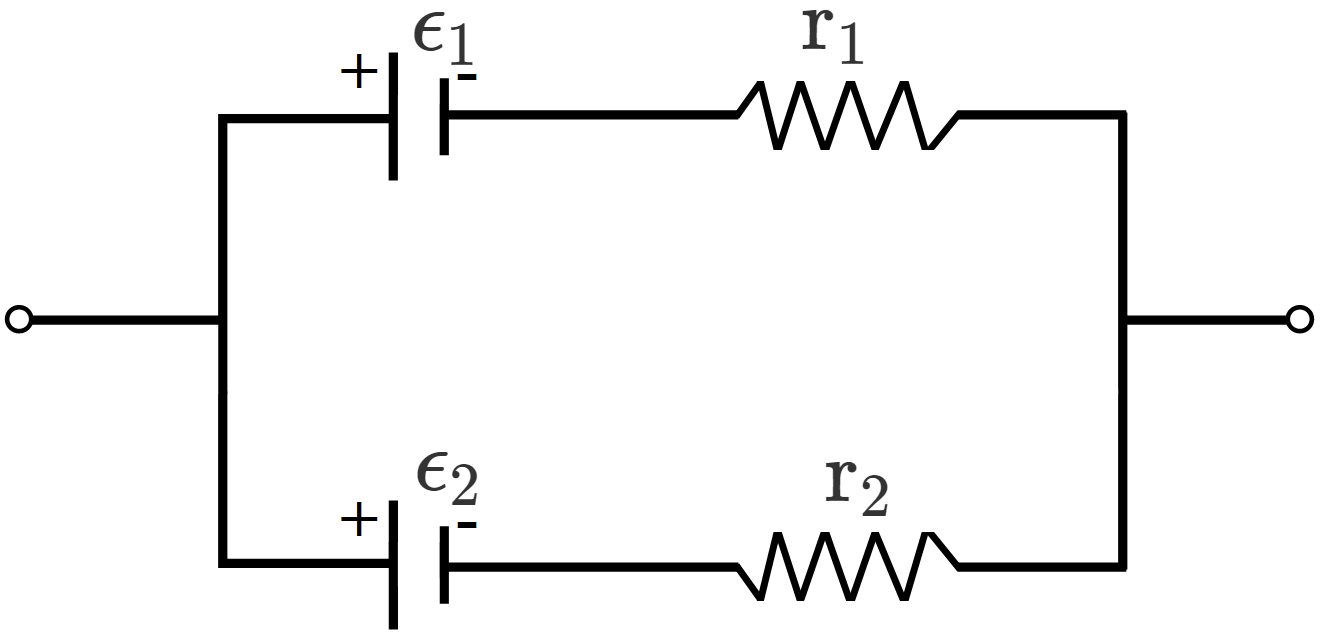
Two non-ideal batteries are connected in parallel. Consider the following statements:
  1. The equivalent emf is smaller than either of the two emfs.
  2. The equivalent internal resistance is smaller than either of the two internal resistances.
  • A
    Both $A$ and $B$ are correct.
  • B
    $A$ is correct but $B$ is wrong.
  • $B$ is correct but $A$ is wrong.
  • D
    Both $A$ and $B$ are wrong.

Answer

Correct option: C.
$B$ is correct but $A$ is wrong.

Equivalent emf $\in_0=\frac{\in_1\text{r}_1+\in_2\text{r}_2}{\text{r}_1+\text{r}_2}$

Equivalent resistance $=\text{r}_0=\frac{\text{r}_1\text{r}_2}{\text{r}_1+\text{r}_2}$
$\phi$ The equivalent emf is smaller than either of the two emfs.
$\phi$ The equivalent internal resistance is smaller than either of the two internal resistances.

Need a full question paper?

Generate a complete, print-ready paper with questions like this in minutes — across 16+ boards, with answer keys.

Start Generating Free

Similar questions

The magnetic flux through a circuit of resistance R changes by an amount ∆∅ in time ∆t, Then the total quantity of electric charge Q, which passing during this time through any point of the circuit is given by
When a slab of dielectric material is introduced between the parallel plates of a capacitor which remains connected to a battery, then charge on plates relative to earlier charge
An electric dipole consists of two opposite charges each of magnitude $1 \,\mu C$ separated by a distance of $2 \,cm$. The dipole is placed in an external field of $10^5 \,N / C$. The maximum torque on the dipole is ......... $N m$
When the object is at distances $u_1$ and $u_2$ the images formed by the same lens are real and virtual respectively and of the same size. Then focal length of the lens is :
If the dipole with charges $\pm q$ are kept perpendicular to each other inside a closed cube, then the total electric flux emerging out of the cube will be:
Two parallel wires in the plane of the paper are distance $X _0$ apart. A point charge is moving with speed $u$ between the wires in the same plane at a distance $X_1$ from one of the wires. When the wires carry current of magnitude $I$ in the same direction, the radius of curvature of the path of the point charge is $R_1$. In contrast, if the currents $I$ in the two wires have direction opposite to each other, the radius of curvature of the path is $R_2$.

If $\frac{x_0}{x_1}=3$, the value of $\frac{R_1}{R_2}$ is.

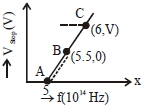
Given figure shows few data points in a photo electric effect experiment for a certain metal. The minimum energy for ejection of electron from its surfface is$.......eV$

(Plancks constant $\left. h =6.62 \times 10^{-34}\, J . s \right)$

Arrange the following in the ascending order of wavelength :

$(A)$ Gamma rays $\left(\lambda_1\right)$

$(B)$ x-ray $\left(\lambda_2\right)$

$(C)$ Infrared waves $\left(\lambda_3\right)$

$(D)$ Microwaves $\left(\lambda_4\right)$

Choose the most appropriate answer from the options given below :

Faraday law of electrolysis indirectly shows
The drift velocity of electrons in silver wire with cross-sectional area $3.14 \times 10^{-6}\,m ^2$ carrying a current of $20\,A$ is. Given atomic weight of $Ag =108$ , density of silver $=10.5 \times 10^3\,kg / m ^3..........\times 10^{-4} m / sec$.