MCQ
Two parallel large thin metal sheets have equal surface charge densities $(\sigma = 26.4 \times 10^{-12}\,c/m^2)$ of opposite signs. The electric field between these sheets is
  • A
    $1.5\,N/C$
  • B
    $1.5\times 10^{-10}\,N/C$
  • $3\,N/C$
  • D
    $3\times 10^{-10}\,N/C$

Answer

Correct option: C.
$3\,N/C$
c
Field between two parallel sheet

$ = \frac{\sigma }{{{ \in _0}}} = \frac{{26.4 \times {{10}^{ - 12}}}}{{8.85 \times {{10}^{ - 12}}}} = 3\,N/C$

Need a full question paper?

Generate a complete, print-ready paper with questions like this in minutes — across 16+ boards, with answer keys.

Start Generating Free

Similar questions

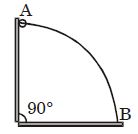
A wire, which passes through the hole in a small bead, is bent in the form of quarter of a circle. The wire is fixed vertically on ground as shown in the figure. The bead is released from near the top of the wire and it slides along the wire without friction. As the bead moves from $A$ to $B$, the force it applies on the wire is
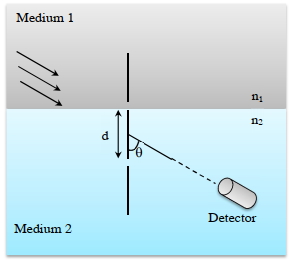
A double slit setup is shown in the figure. One of the slits is in medium $2$ of refractive index $n_2$. The other slit is at the interface of this medium with another medium $1$ of refractive index $n_1\left(\neq n_2\right)$. The line joining the slits is perpendicular to the interface and the distance between the slits is $d$. The slit widths are much smaller than $d$. A monochromatic parallel beam of light is incident on the slits from medium $1$. A detector is placed in medium $2$ at a large distance from the slits, and at an angle $\theta$ from the line joining them, so that $\theta$ equals the angle of refraction of the beam. Consider two approximately parallel rays from the slits received by the detector.

Which of the following statement($s$) is (are) correct?

$(A)$ The phase difference between the two rays is independent of $d$.

$(B)$ The two rays interfere constructively at the detector.

$(C)$ The phase difference between the two rays depends on $n _1$ but is independent of $n_2$.

$(D)$ The phase difference between the two rays vanishes only for certain values of $d$ and the angle of incidence of the beam, with $\theta$ being the corresponding angle of refraction.
$ABCDEF$ is a regular hexagon and forces represented in magnitude and direction by  $AB, AC,AD, AE$ and $AF$ act at $A$. Their resultant is :
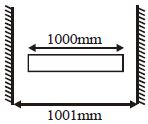
$A$ rod of length $1000\, mm$ and coefficient of linear expansion $a = 10^{-4}$ per degree is placed symmetrically between fixed walls separated by $1001\, mm$. The Young’s modulus of the rod is $10^{11} N/m^2$. If the temperature is increased by $20^o C$, then the stress developed in the rod is ........... $MPa$
The e.m.f. of a cell is $E\, volts$ and internal resistance is $r$ $ohm$. The resistance in external circuit is also $r$ $ohm$. The p.d. across the cell will be
The magnitude of torque on a particle of mass $1\,kg$ is $2.5\, Nm$ about the origin. If the force acting on it is $1\,N$, and the distance of the particle from the origin is $5\,m$, the angle between the force and the position vector is (in radians)
The amplification factor of a triode is $20$. Its plate resistance is $10\, kilo\, ohms$. Mutual conductance is
In Rutherford scattering experiment, what will be the correct angle for $\alpha $ scattering for an impact parameter $b = 0$.....$^o$
The maximum number of possible interference maxima for slit-separation equal to twice the wavelength in Young’s double-slit experiment is
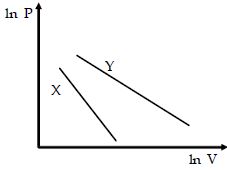
For two different gases $X$ and $Y,$ having degrees of freedom $f_1$ and $f_2$ and molar heat capacities at constant volume $C_{v_1}$ and $C_{v_2}$ respectively, for adiabatic process , the $\ln P$ versus $\ln V$ graph is plotted as shown :-