Question
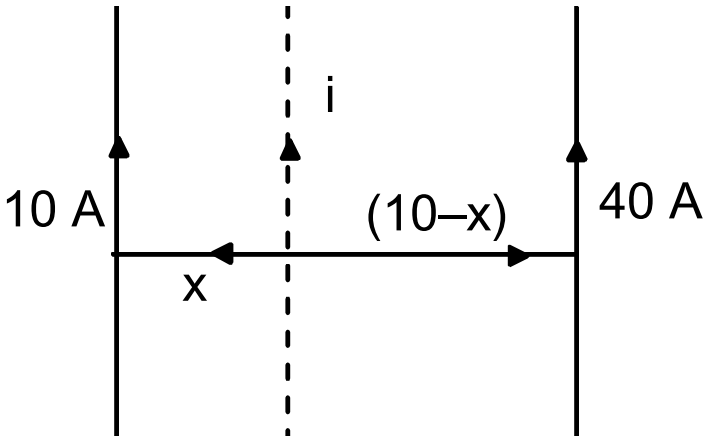
Two parallel wires seprated by a distance of 10cm carry currents of 10A and 40A along-the same direction. Where should a third current be placed so that it experiences no magnetic force?
Answer


$\frac{\mu_010\text{i}}{2\pi\text{x}}=\frac{\mu_0\text{i}40}{2\pi(10-\text{x})}$
$\Rightarrow\frac{10}{\text{x}}=\frac{40}{10-\text{x}}\Rightarrow\frac{1}{\text{x}}=\frac{4}{10-\text{x}}$
$\Rightarrow10-\text{x} = 4\text{x}$
$\Rightarrow5\text{x} = 10$
$\Rightarrow\text{x} = 2\text{cm}$
The third wire should be placed 2cm from the 10A wire and 8 cm from 40A wire.

Need a full question paper?

Generate a complete, print-ready paper with questions like this in minutes — across 16+ boards, with answer keys.
Start Generating Free

Similar questions

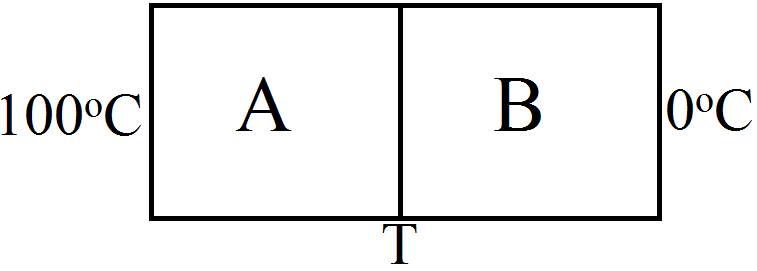
Two metal cubes $A$ and $B$ of same size are arranged as shown in figure. The extreme ends of the combination are maintained at the indicated temperatures. The arrangement is thermally insulated. The coefficient of thermal conductivity of $A$ and $B$ are $300 W/m  {}^\circ C$ and $200 W/m  {}^\circ C$ respectively. After steady state is reached, what will be the temperature T of the interface?

A pendulum clock gives correct time at $20^{\circ} \mathrm{C}$ at a place where $\mathrm{g}=9.800 \mathrm{~m} \mathrm{~s}^{-2}$. The pendulum consists of a light steel rod connected to a heavy ball. It is taken to a different place where $\mathrm{g}=9.788 \mathrm{~m} \mathrm{~s}^{-2}$. At what temperature will it give correct time ? Coefficient of linear expansion of steel $=12 \times 10^{-6}{ }^{\circ} \mathrm{C}^{-1}$.
Consider a wire of length 4m and cross-sectional area $1mm^2$ carrying a current of 2A. If each cubic metre of the material contains $10^{29}$ free electrons, find the average time taken by an electron to cross the length of the wire.
Consider the situation of the previous problem:
  1. Find the tension in the string in equilibrium.
  2. Suppose the ball is slightly pushed aside and released. Find the time period of the small oscillations.
A cylindrical piece of cork of density of base area A and height h floats in a liquid of density $\rho_1.$ The cork is depressed slightly and then released. Show that the cork oscillates up and down simple harmonically with a period $\text{T}=2\pi\sqrt{\frac{\text{h}\rho}{\rho_1\text{g}}}$ where $\rho$ is the density of cork. (Ignore damping due to viscosity of the liquid).
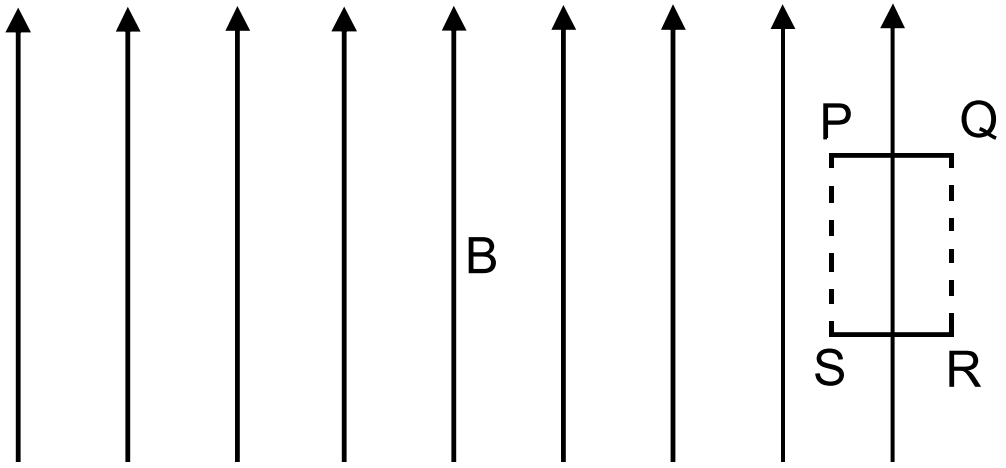
Sometimes we show an idealised magnetic field which is uniform in a given region and falls to zero abruptly. One such field is represented in figure. Using Ampere's law over the path PQRS, show that such a field is not possible.
A particle slides on the surface of a fixed smooth sphere starting from the topmost point. Find the angle rotated by the radius through the particle, when it leaves contact with the sphere.
An artificial satellite is revolving around a planet of mass M and radius R, in a circular orbit of radius r. From Kepler’s Third law about the period of a satellite around a common central body, square of the period of revolution T is proportional to the cube of the radius of the orbit r. Show using dimensional analysis, that $\text{T}=\frac{\text{k}}{\text{R}}\sqrt{\frac{\text{r}^3}{\text{g}}},$ where k is a dimensionless constant and g is acceleration due to gravity.
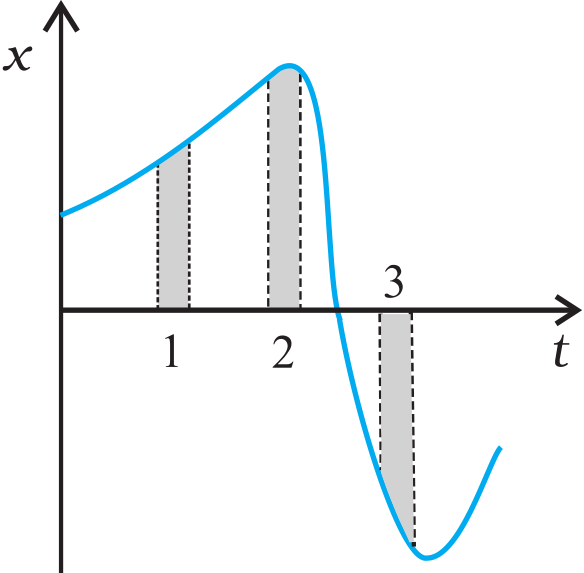
Gives the x-t plot of a particle in one-dimensional motion. Three different equal intervals of time are shown. In which interval is the average speed greatest, and in which is it the least? Give the sign of average velocity for each interval.
Calculate the moment of inertia of uniform circular disc of mass 500 g , radius 10 cm about
i. diameter of the disc
ii. the axis tangent to the disc and parallel to its diameter and
iii. the axis through the centre of the disc and perpendicular to its plane.