MCQ
Two particles $A$ and $B$ having equal charges $+6\,C$, after being accelerated through the same potential difference, enter in a region of uniform magnetic field and describe circular paths of radii $2\,cm$ and $3\,cm$ respectively. The ratio of mass of $A$ to that of $B$ is
  • $\frac{4}{9}$
  • B
    $\frac{9}{5}$
  • C
    $\frac{1}{2}$
  • D
    $\frac{1}{3}$

Answer

Correct option: A.
$\frac{4}{9}$
a
Let $\mathrm{v}$ be velocity ecquired by the charged particle when accelerated through the potential difference $\mathrm{V}$

$\therefore$ $\frac{1}{2} \mathrm{mv}^{2}=\mathrm{qV}$

or $\quad \mathrm{v}=\sqrt{\frac{2 \mathrm{qV}}{\mathrm{m}}}$

As the charged particle describes a circular path of radius $\mathrm{R}$ in the uniform magnetic field.

$\therefore \quad \frac{\mathrm{mv}^{2}}{\mathrm{R}}=\mathrm{qvB}$

or $\quad \mathrm{R}=\frac{\mathrm{mv}}{\mathrm{qB}}=\frac{\mathrm{m}}{\mathrm{qB}} \sqrt{\frac{2 \mathrm{qV}}{\mathrm{m}}}=\frac{\sqrt{\mathrm{m}}}{\mathrm{B}} \cdot \sqrt{\frac{2 \mathrm{V}}{\mathrm{q}}}$

As $\mathrm{q}, \mathrm{B}$ and $\mathrm{V}$ remain the same.

$\therefore \quad \mathrm{R} \propto \sqrt{\mathrm{m}}$

$\frac{\mathrm{R}_{\mathrm{A}}}{\mathrm{R}_{\mathrm{B}}}=\sqrt{\frac{\mathrm{m}_{\mathrm{A}}}{\mathrm{m}_{\mathrm{B}}}}$

$\Rightarrow \quad \frac{\mathrm{m}_{\mathrm{A}}}{\mathrm{m}_{\mathrm{B}}}=\left(\frac{\mathrm{R}_{\mathrm{A}}}{\mathrm{R}_{\mathrm{B}}}\right)^{2}=\left(\frac{2}{3}\right)^{2}=\frac{4}{9}$
Need a full question paper?

Generate a complete, print-ready paper with questions like this in minutes — across 16+ boards, with answer keys.

Start Generating Free

Similar questions

Water falls from a height of 200 m into a pool. Calculate the rise in temperature of the water assuming no heat dissipation from the water in the pool.
$\left(\right.$ Take $g=10 \mathrm{~m} / \mathrm{s}^{2}$, specific heat of water $\left.=4200 \mathrm{~J} /(\mathrm{kg} \mathrm{K})\right)$
A train moves towards a stationary observer with a speed $34 \,m / s$. The train sounds a whistle and its frequency registered by the observer is $f_1$. If the speed of the train is reduced to $17 \,m / s$, the frequency registered is $f_2$. If the speed of sound is $340 \,m / s$ then the ratio $\frac{f_1}{f_2}$ is ..........
In Young double slit experiment, when two light waves form third minimum, they have
The dimensions of $RC$ is

($C$ and $R$ represent capacitance and resistance respectively)

Image
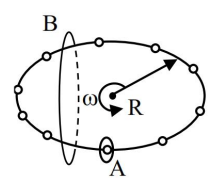
N equally spaced charges each of value q , are placed on a circle of radius R . The circle rotates about its axis with an angular velocity $\omega$ as shown in the figure. A bigger Amperian loop B encloses the whole circle where as a smaller Amperian loop A encloses a small segment. The difference between enclosed currents, $I_A-I_B$, for the given Amperian loops is
A metallic rod oflength '$l$' is tied to a string oflength $2l$. and made to rotate with angular speed w on a horizontal table with one end of the string fixed. Ifthere is a vertical magnetic field '$B$' in the region, the $e.m.f.$ induced across the ends of the rod is
A thin disc of radius $R$ and mass $M$ has charge $q$ uniformly distributed on it. It rotates with angular velocity $\omega$. The ratio of magnetic moment and angular momentum for the disc is
A train moves towards a stationary observer with speed $34\, m/s$. The train sounds a whistle and its frequency registered by the observer is $f_1$. If the speed of the train is reduced to $17\, m/s$, the frequency registered is $f_2$. If speed of sound is $340\, m/s$, then the ratio $f_1/f_2$ is
The torque of force $\vec F =  - 2\hat i + 2\hat j + 3\hat k$ acting on a point $\vec r = \hat i - 2\hat j + \hat k$ about origin will be
A string of length $L$ is fixed at one end and carries a mass $M$ at the other end. The string makes $2/\pi$ revolutions per second around the vertical axis through the fixed end as shown in the figure, then tension in the string is