MCQ
Two particles $A$ and $B$, move with constant velocities ${\vec v_1}$ and ${\vec v_2}$. At the initial moment their position vectors are ${\vec r_1}$ and ${\vec r_2}$ respectively. The condition for their collision is
  • A
    ${\vec r_1} - {\vec r_2} = {\vec v_1} - {\vec v_2}$
  • $\frac{{{{\vec r}_1} - {{\vec r}_2}}}{{\left| {{{\vec r}_1} - {{\vec r}_2}} \right|}} = \frac{{{{\vec v}_2} - {{\vec v}_1}}}{{\left| {{{\vec v}_2} - {{\vec v}_1}} \right|}}$
  • C
    ${{\vec r}_1}.{{\vec v}_1} = {{\vec r}_2}.{{\vec v}_2}$
  • D
    ${{\vec r}_1} \times {{\vec v}_1} = {{\vec r}_2} \times {{\vec v}_2}$
Answer

Correct option: B.
$\frac{{{{\vec r}_1} - {{\vec r}_2}}}{{\left| {{{\vec r}_1} - {{\vec r}_2}} \right|}} = \frac{{{{\vec v}_2} - {{\vec v}_1}}}{{\left| {{{\vec v}_2} - {{\vec v}_1}} \right|}}$
b
For two particles to collide, the direction of the relative velocity of one with respect to other should be directed towands the relative position of the other particle

ie. $\frac{\vec{\mathrm{r}}_{1}-\vec{\mathrm{r}}_{2}}{\left|\vec{\mathrm{r}}_{1}-\vec{\mathrm{r}}_{2}\right|} \rightarrow$ clivection of relative position of $1 \mathrm{w.r.t}$ $2$

 $\frac{\vec{\mathrm{v}}_{2}-\vec{\mathrm{v}}_{1}}{\left|\vec{\mathrm{v}}_{2}-\vec{\mathrm{v}}_{1}\right|} \rightarrow$ direction of velocity of $2 \mathrm{w}$ $r.t. 1$

so for collision of $\mathrm{A} \& \mathrm{B}$

$\frac{\overrightarrow{\mathrm{r}}_{1}-\overrightarrow{\mathrm{r}}_{2}}{\left|\overrightarrow{\mathrm{r}}_{1}-\overrightarrow{\mathrm{r}}_{2}\right|}=\frac{\overrightarrow{\mathrm{v}}_{2}-\overrightarrow{\mathrm{v}}_{1}}{\left|\overrightarrow{\mathrm{v}}_{2}-\overrightarrow{\mathrm{v}}_{1}\right|}$

Need a full question paper?

Generate a complete, print-ready paper with questions like this in minutes — across 16+ boards, with answer keys.

Start Generating Free

Similar questions

The upper end of a wire $1\,m$ long and $4\,mm$ radius is clamped. The lower end is twisted by an angle of $30^o$. The angle of shear is ...... $^o$
Range of a bob of mass $1\, kg$ is $80\,m$ while it attains maximum height $20\,m$. Its  change in momentum in complete motion ............ $N-s$
The equation of a particle executing simple harmonic motion is given by $x =\sin \pi\left( t +\frac{1}{3}\right) m$. At $t =1 \,s$, the speed of particle will be .......... $cm s ^{-1}$ (Given : $\pi=3.14$ )
The pressure of an ideal gas is written as $\text{p}=\frac{2\text{E}}{3\text{v}}.$ Here E refers to:
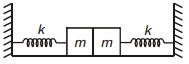
An assembly of identical spring-mass systems is placed on a smooth horizontal surface as shown. At this instant, the springs are relaxed. The left mass is displaced to the/left and theiright mass is displaced to the right by same distance and released. The resulting collision is elastic. The time period of the oscillations of system is
Masses m and 3m are attached to the two ends of a spring of constant k. If the system vibrates freely, the period of oscillation will be:
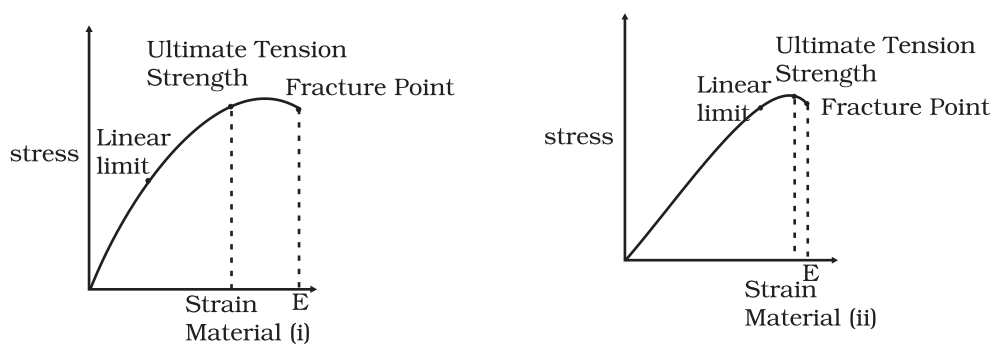
The stress - strain graphs for two materials are shown in (assume same scale).

  1. Material (ii) is more elastic than material (i) and hence material (ii) is more brittle.
  2. Material (i) and (ii) have the same elasticity and the same brittleness.
  3. Material (ii) is elastic over a larger region of strain as compared to (i).
  4. Material (ii) is more brittle than material (i).
Which of the following processes is reversible
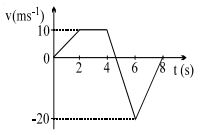
The figure shows a velocity-time graph of a particle moving along a straight line  The correct acceleration-time graph of the particle is shown as
A spring is stretched by $5 \,\mathrm{~cm}$ by a force $10 \,\mathrm{~N}$. The time period of the oscillations when a mass of $2 \,\mathrm{~kg}$ is suspended by it is :(in $s$)