MCQ
Two particles $A$ and $B,$ move with constant  velocities $\vec v_1$ and $\vec v_2$. At the initial moment their position vectors are $\vec r_1$ and $\vec r_2$ respectively. The condition for particles $A$ and $B$ for their collision is
  • $\frac{{\overrightarrow {{r_1}} - \overrightarrow {{r_2}} }}{{\left| {\overrightarrow {{r_1}} - \overrightarrow {{r_2}} } \right|}} = \;\frac{{\overrightarrow {{v_2}} - \overrightarrow {{v_1}} }}{{\left| {\overrightarrow {{v_2}} - \overrightarrow {{v_1}} } \right|}}\;\;\;$
  • B
    $\overrightarrow {{r_1}} $ -$\overrightarrow {{r_2}} $ = $\overrightarrow {{v_1}} $ -$\overrightarrow {{v_2}} $
  • C
    $\;\overrightarrow {{r_1}} $ .$\;\overrightarrow {{v_1}} $ =$\overrightarrow {{r_2}} $ .$\;\overrightarrow {{v_2}} $
  • D
    $\;\overrightarrow {{r_1}} \times \overrightarrow {{v_1}}=\overrightarrow {{r_2}}  \times \overrightarrow {{v_2}} $
Answer

Correct option: A.
$\frac{{\overrightarrow {{r_1}} - \overrightarrow {{r_2}} }}{{\left| {\overrightarrow {{r_1}} - \overrightarrow {{r_2}} } \right|}} = \;\frac{{\overrightarrow {{v_2}} - \overrightarrow {{v_1}} }}{{\left| {\overrightarrow {{v_2}} - \overrightarrow {{v_1}} } \right|}}\;\;\;$
a
$\begin{array}{l}
\,\,\,\,\,\,\,\,\,\,\,\,\,\,\,\,Let\,the\,particles\,A\,and\,B\,collide\\
at\,time\,t.\,For\,their\,collision,\,the\,position\\
vectors\,of\,both\,particles\,sholud\,be\,\\
same\,at\,time\,t,\,i.e.,\\
{{\vec r}_1} + {{\vec v}_1}t = {{\vec r}_2} + {{\vec v}_2}t\,;\,{{\vec r}_1} - {{\vec r}_2} = {{\vec v}_2}t - {{\vec v}_1}t\\
 = \left( {{{\vec v}_2} - {{\vec v}_1}} \right)t\,\,\,\,\,\,\,\,\,\,\,\,\,\,\,\,\,\,\,\,\,\,\,\,\,\,\,\,\,\,\,\,\,\,\,\,\,\,\,\,\,\,\,\,\,\,...\left( i \right)
\end{array}$

$\begin{array}{l}
Also,\,\left| {\,{{\vec r}_1} - {{\vec r}_2}} \right| = \left| {{{\vec v}_2} - {{\vec v}_1}} \right|t\,\,or\,t = \frac{{\left| {\,{{\vec r}_1} - \vec r} \right|}}{{\left| {{{\vec v}_2} - {{\vec v}_1}} \right|}}\\
Substituting\,this\,value\,of\,t\,in\,eqn.\,\left( i \right),\\
we\,get\,\\
\,\,\,\,\,\,\,\,\,\,\,\,\,\,\,{{\vec r}_1} - {{\vec r}_2} = \left( {{{\vec v}_2} - {{\vec v}_1}} \right)\frac{{\left| {\,{{\vec r}_1} - \vec r} \right|}}{{\left| {{{\vec v}_2} - {{\vec v}_1}} \right|}}\\
or\,\frac{{\left| {\,{{\vec r}_1} - {{\vec r}_2}} \right|}}{{\left| {\,{{\vec r}_1} - {{\vec r}_2}} \right|}} = \frac{{\left( {{{\vec v}_2} - {{\vec v}_1}} \right)}}{{\left| {{{\vec v}_2} - {{\vec v}_1}} \right|}}
\end{array}$

Need a full question paper?

Generate a complete, print-ready paper with questions like this in minutes — across 16+ boards, with answer keys.

Start Generating Free

Similar questions

A solid cylinder $(i)$ rolls down $(ii)$ slides down an inclined plane. The ratio of the accelerations in these conditions 
Two closed pipe produce $10$ beats per second when emitting their fundamental nodes. If their length are in ratio of $25 : 26$. Then their fundamental frequency in $Hz$, are
Two sound sources each emitting waves of wavelength $\lambda$ are fixed a given distance apart and an observer moves from one source to another with velocity $u$. Then number of beats heard by him per second is
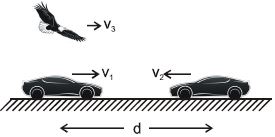
A bird flies to and fro between two cars which move with velocity $v_1 = 20\, m/s$ and $v_2 = 30\, m/s$. If the speed of the bird is $v_3 = 10\, m/s$ and the initial distance of  separation between them is $d = 2\, km$, find the total distance covered by the bird till  the cars meet.........$m$
The net applied force on a body in uniform circular motion should always be
A solid sphere is thrown up a rough incline. The sphere rolls up without slipping and eventually comes down rolling without slipping. The direction of rolling friction in upward and downward motion respectively is ............
In the context of accuracy of measurement and significant figures in expressing results of experiment, which of the following is/are correct

$(1)$ Out of the two measurements $50.14 \,cm$ and $0.00025$ ampere, the first one has greater accuracy

$(2)$ If one travels $478\, km$ by rail and $397\, m$. by road, the total distance travelled is $478\, km.$

$Assertion :$ In pressure-temperature $(P-T)$ phase diagram of water, the slope of the melting curve is found to be negative.
$Reason :$ Ice contracts on melting to water.
Suppose that two heat engines are connected in series, such that the heat exhaust of the first engine is used as the heat input of the second engine as shown in figure. The efficiencies of the engines are $\eta_1$  and $\eta_2$, respectively. The net efficiency of the combination is given by
The coordinates of a moving particle at any time $‘t’$ are given by $ x = \alpha t^3$ and $y = \beta t^3$. The speed of the particle at time $‘t’$ is given by