MCQ
Two particles are moving along two long straight lines, in the same plane, with the same speed $= 20 \,\,cm/s$. The angle between the two lines is $60^o$, and their intersection point is $O$. At a certain moment, the two particles are located at distances $3\,m$ and $4\,m$ from $O$, and are moving towards $O$. Subsequently, the shortest distance between them will be
  • A
    $50 \,\,cm$
  • B
    $40\sqrt 2 \,\, cm$
  • C
    $50\sqrt 2 \,\,cm$
  • $50\sqrt 3 \,\,cm$

Answer

Correct option: D.
$50\sqrt 3 \,\,cm$
d
$v_{Q}=-20 \hat{i}$

$v_{P}=-20 \cos 60 \hat{i}-20 \sin 60^{\circ} \hat{j}$

$=-10 \hat{i}-10 \sqrt{3} \hat{j}$

Assuming $P$ to be at rest, $v_{Q P}=v_{Q}-v_{P}=-10 \hat{i}+10 \sqrt{3} \hat{j}$

Now, $\therefore \tan \theta=\frac{10 \sqrt{3}}{10}=\sqrt{3}$ or $\theta=60^{\circ}$

where, theta is the angle of $v_{Q P}$ from $\mathrm{x}$ $-axis$ towards positive $y-axis.$

Shortest distance $=P M=P N \sin 60^{\circ}$

$=(100) \frac{\sqrt{3}}{2}=50 \sqrt{3} \mathrm{cm}$

Need a full question paper?

Generate a complete, print-ready paper with questions like this in minutes — across 16+ boards, with answer keys.

Start Generating Free

Similar questions

Binding energy per nucleon of a fixed nucleus $X^A$ is $8\ MeV$ . It absorbs a neutron moving with kinetic energy $2\ MeV$ and converts into $Y$ , emitting two photon of energy $1\ MeV$ and $4\ MeV$ respectively one after the other. The binding energy of per nucleon of $Y$ (in $MeV$ ) is
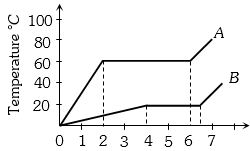
Two substances $A$ and $B$ of equal mass m are heated at uniform rate of $6\, cal s^{-1}$ under similar conditions. $A$ graph between temperature and time is shown in figure. Ratio of heat absorbed ${H_A}/{H_B}$ by them for complete fusion is
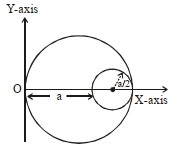
A circular hole of radius $\left(\frac{ a }{2}\right)$ is cut out of a circular disc of radius $'a'$ as shown in figure. The centroid of the remaining circular portion with respect to point $'O'$ will be :
A hollow cylinder is rolling on an inclined plane, inclined at an angle of ${30^o}$ to the horizontal. Its speed after travelling a distance of $10\ m$ will be .......... $m/s$
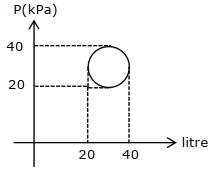
In the reported figure, heat energy absorbed by a system in going through a cyclic process is $......\,\pi J$
If vectors $\overrightarrow {A} = cos\omega t\hat i + sin\omega t\hat j$ and $\overrightarrow {B} = cos\frac{{\omega t}}{2}\hat i + sin\frac{{\omega t}}{2}\hat j$ are functions of time, then the value of $t$ at which they are orthogonal to each other is 
An oil drop carries six electronic charges, has a mass of $1.6 \times 10^{-12} g$ and falls with a terminal velocity in air. The magnitude of vertical electrical electric field required to  make the drop move upward with the same speed as was formely moving is ........$kN/C$
A ray of light propagates from glass (refractive index $= 3/2$) to water (refractive index $= 4/3$). The value of the critical angle
A bullet of mass $5 \,g$ is shot from a gun of mass $5 \,kg$. The muzzle velocity of the bullet is $500\, m/s$. The recoil velocity of the gun is ........... $m/s$
The binding energy of nucleons in a nucleus can be affected by the pairwise Coulomb repulsion. Assume that all nucleons are uniformly distributed inside the nucleus. Let the binding energy of a proton be $E_b^p$ and the binding energy of a neutron be $E_b^n$ in the nucleus.

Which of the following statement($s$) is(are) correct?

$(A)$ $E_b^p-E_b^n$ is proportional to $Z(Z-1)$ where $Z$ is the atomic number of the nucleus.

$(B)$ $E_b^p-E_b^n$ is proportional to $A^{-\frac{1}{3}}$ where $A$ is the mass number of the nucleus.

$(C)$ $E_b^p-E_b^n$ is positive.

$(D)$ $E_b^p$ increases if the nucleus undergoes a beta decay emitting a positron.