MCQ
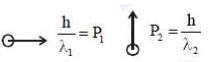
Two particles move at right angle to each other. Their de Broglie wavelengths are ${\lambda _1}$ and ${\lambda _2}$ respectively. The particles suffere perfectly inelastic collision. The de Broglie wavelength $\lambda $ , of the final particle, is given by
  • A
    $\lambda  = \sqrt {{\lambda _1}{\lambda _2}} $
  • B
    $\lambda  = \frac{{{\lambda _1} + {\lambda _2}}}{2}$
  • C
    $\frac{2}{\lambda } = \frac{1}{{{\lambda _1}}} + \frac{1}{{{\lambda _2}}}$
  • $\frac{1}{{{\lambda ^2}}} = \frac{1}{{\lambda _1^2}} + \frac{1}{{\lambda _2^2}}$
Answer

Correct option: D.
$\frac{1}{{{\lambda ^2}}} = \frac{1}{{\lambda _1^2}} + \frac{1}{{\lambda _2^2}}$
d
$\vec{P}_{1}=\frac{h}{\lambda_{1}} \hat{i}$ and $\vec{P}_{2}=\frac{h}{\lambda_{2}} \hat{j}$

Using momentum conservation

$\vec{P}=\vec{P}_{1}+\vec{P}_{2}=\frac{h}{\lambda_{1}} \hat{i}+\frac{h}{\lambda_{2}} \hat{j}$

$|\vec P| = \sqrt {{{\left( {\frac{h}{{{\lambda _1}}}} \right)}^2} + {{\left( {\frac{h}{{{\lambda _2}}}} \right)}^2}} $

$\frac{h}{\lambda}=\sqrt{\left(\frac{h}{\lambda_{1}}\right)^{2}+\left(\frac{h}{\lambda_{2}}\right)^{2}}$

$\frac{1}{\lambda^{2}}=\frac{1}{\lambda_{1}^{2}}+\frac{1}{\lambda_{2}^{2}}$

Need a full question paper?

Generate a complete, print-ready paper with questions like this in minutes — across 16+ boards, with answer keys.

Start Generating Free

Similar questions

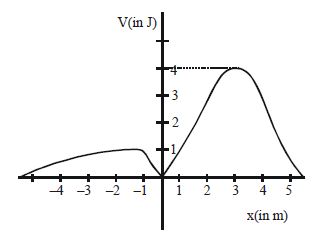
A point particle of mass $0.\ 5 kg$ is moving along the $x-$ axis under a force described by the potential energy $V$ shown below. It is projected towards the right from the origin with a speed $v$ . What is the minimum value of $v$ for which the particle will escape infinitely far away from the origin ? ............... $\ ms^{-1}$
An ideal gas is in thermodynamic equilibrium. The number of degrees of freedom of a molecule of the gas in $n$. The internal energy of one mole of the gas is $U_n$ and the speed of sound in the gas is $v_n$. At a fixed temperature and pressure, which of the following is the correct option?
Given below are two statements : one is labelled as Assertion $A$ and the other is labelled as Reason $R$.

Assertion $A$ : When a body is projected at an angle $45^{\circ}$, it's range is maximum.

Reason $R$ : For maximum range, the value of $\sin 2 \theta$ should be equal to one.

In the light of the above statements, choose the correct answer from the options given below :

Two generators $S_1$ and $S_2$ produce water wave of equal frequency. A point $P$ is located such that $(S_1P -S_2P)$ is equal to half a wavelength. When operated alone, $S_1$ produces an oscillation of amplitude $2a$ at $P$ while $S_2$ produces an oscillation of amplitude $a$ . If the generators are operated in phase, which graph correctly shows the resultant oscillation at $P$ ?
A uniform disc of radius $R$ lies in $x-y$ plane with its centre at origin. Its moment of inertia about $z$ -axis is equal to its moment of inertia about line $y = x + c$. The value of $c$ is :-
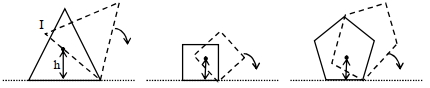
Consider regular polygons with number of sides $\mathrm{n}=3,4,5, \ldots$. as shown in the figure. The center of mass of all the polygons is at height $\mathrm{h}$ from the ground. They roll on a horizontal surface about the leading vertex without slipping and sliding as depicted. The maximum increase in height of the locus of the center of mass for each polygon is $\Delta$. Then $\Delta$ depends on $n$ and $h$ as
An electron rotates in a circle around a nucleus having positive charge $Ze$. Correct relation between total energy $(E)$ of electron to its potential energy $(U)$ is :
$A$ block of mass $m$ is kept in an elevation which starts moving downward with an acceleration $a$ as shown in figure. The block is observed by two observers $A$ and $B$ for a time interval $t_0$. The observer $B$ finds that the work done by pseudo force on the block is
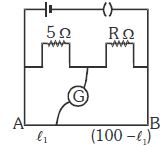
The resistance in the two arms of a meter bridge are $5\,\Omega $ and $R\,\Omega $, respectively. When the resistance $R$ is shunted with an equal resistance, the new balance point is at $1.6\, l_1$. The resistance $‘R’$ is ................. $\Omega$
If the kinetic energy of a moving body becomes four times its initial kinetic energy, then the percentage change in its momentum will be $...\%$