MCQ
Two particles start simultaneously from the same point and move along two straight lines, one with uniform velocity $v$ and other with a uniform acceleration $a.$ If $\alpha$ is the angle between the lines of motion of two particles then the least value of relative velocity will be at time given by
  • A
    $(v/a)\,\, sin \,\,\alpha$
  • $(v/a)\,\, cos \,\,\alpha$
  • C
    $(v/a)\,\, tan \,\,\alpha$
  • D
    $(v/a)\,\,cot \,\,\alpha$

Answer

Correct option: B.
$(v/a)\,\, cos \,\,\alpha$
b
$\nu_{r}$ is subtraction of vectors. Hence,

$\nu_{r}^{2}=x(\operatorname{say})=\nu^{2}+(a t)^{2}-2 v(a t) \cos \alpha$

Now, $\nu_{r}$ will be minimum when $x$ is minimum

Hence $\frac{d x}{d t}=0$ or $2 a^{2} t-2 \nu a \cos \alpha=0$

$\mathrm{t}=\frac{\nu \cos \alpha}{a}$

Need a full question paper?

Generate a complete, print-ready paper with questions like this in minutes — across 16+ boards, with answer keys.

Start Generating Free

Similar questions

Two immiscible liquid are filled in conical flask as shown in figure. The area of cross section is shown, a small hole of area a is made in lower end of cone. Find speed of liquid flow from hole
A liquid drop of mass $m$ and radius $r$ is falling from great height. Its velocity is proportional to ............
Weight of a body of mass m decreases by $1\%$ when it is raised to height $h$ above the earth’s surface. If the body is taken to a depth h in a mine, change in its weight is
Neon gas of a given mass expands isothermally to double volume. What should be the further fractional decrease in pressure, so that the gas when adiabatically compressed from that state, reaches the original state?
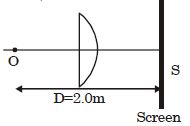
A plano-convex thin lens is used to obtain the image of a point object $O$ on the screen $S$ as shown in figure. The thickness of the lens in the middle is $0.5\ cm$ and refractive index of the material of the lens is $1.5$ . If the separation $D$ between the object and the screen is to be minimum, then the aperture diameter of the lens should be.....$cm$ (consider lens as thin)
In a wire of cross section radius $r,$ free electrons travel with drift velocity $v$ when a current $I$ flows through the wire. What is the current in another wire of half the radius and of the same material when the drift velocity is $2v$  ?
An isolated rail car originally moving with speed $v_0$ on a straight, frictionles, level track contains a large amount of sand. $A$ release valve on the bottom of the car malfunctions, and sand begins to pour out straight down relative to the rail car. Is momentum conserved in this process?
A metal wire has mass $(0.4 \pm 0.002)\,g$, radius $(0.3 \pm 0.001)\,mm$ and length $(5 \pm 0.02) \,cm$. The maximum possible percentage error in the measurement of density will nearly be $.......\%$
A plane electromagnetic wave of frequency $50\, MHz$ travels in free space along the positive $x-$ direction. At a particular point in space and time, $\vec E = 6.3\,\hat j\,V/m$ . The corresponding magnetic field $\vec B$, at that point will be
Surface tension of a soap bubble is $2.0 \times 10^{-2}\; Nm ^{-1}$. Work done to increase the radius of soap bubble from $3.5\; cm$ to $7\; cm$ will be $.........\times 10^{-4}\,J$ [Take $\pi=\frac{22}{7}$ ]