- A$\Big(\frac{\text{R}_1}{\text{R}_2}\Big)^{\frac{1}{2}}$
- B$\frac{\text{R}_1}{\text{R}_2}$
- C$\Big(\frac{\text{R}_1}{\text{R}_2}\Big)^2$
- D$\text{R}_1\text{R}_2.$
Explanation:
Particles X and Y of respective masses m1 and m2 are carrying charge q describing circular paths with respective radii R1 and R2 such that,
$\text{R}_1=\frac{\text{m}_1\text{v}_1}{\text{qB}}$
$\text{R}_1=\frac{\text{m}_2\text{v}_2}{\text{qB}}$
Since both the particles are accelerated through the same potential difference, both will have the same kinetic energy.
$\therefore\frac{1}{2}\text{m}_1\text{v}_1^2=\frac{1}{2}\text{m}_2\text{v}_2^2$
$\because\text{R}_1=\frac{\text{m}_1\text{v}_1}{\text{qB}}\Rightarrow\text{v}_1=\frac{\text{R}_1\text{qB}}{\text{m}_1}$
And,
$\text{R}_2=\frac{\text{m}_2\text{v}_2}{\text{qB}}\Rightarrow\text{v}_2=\frac{\text{R}_2\text{qB}}{\text{m}_2}$
$\therefore\text{m}_1\Big(\frac{\text{R}_1\text{qB}}{\text{m}_1}\Big)^2=\text{m}_2\Big(\frac{\text{R}_2\text{qB}}{\text{m}_2}\Big)^2$
$\Rightarrow\frac{\text{m}_1}{\text{m}_2}=\frac{\text{R}_1^2}{\text{R}_2^2}=\Big(\frac{\text{R}_1}{\text{R}_2}\Big)^2$
Generate a complete, print-ready paper with questions like this in minutes — across 16+ boards, with answer keys.
The magnetic flux through a circuit of resistance R changes by an amount ∆∅ in time ∆t, Then the total quantity of electric charge Q, which passing during this time through any point of the circuit is given by
|
(a) Q = |
(b) Q = |
(c) Q = |
(d) Q = |
Before the saturation state of a diode at the plate voltages of 400 V and 200 V respectively the currents are i1 and i2 respectively. The ratio i1/i2 will be
|
(a) |
(b) 2 |
(c) 2 | (d) 1/2 |
A magnet oscillating in a horizontal plane has a time period of 2 second at a place where the angle of dip is 30o and 3 seconds at another place where the angle of dip is 60o. The ratio of resultant magnetic fields at the two places is
|
(a) |
(b) |
(c) |
(d) |
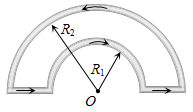
The magnetic induction at the centre O in the figure shown is

|
(a) |
(b) |
(c) |
(d) |
A coil of N turns and mean cross-sectional area A is rotating with uniform angular velocity w about an axis at right angle to uniform magnetic field B. The induced e.m.f. E in the coil will be
|
(a) NBA sinwt |
(b) NB w sinwt |
(c) NB/A sinwt |
(d) NBA w sinwt |