MCQ
Two particles $X$ and $Y$ having equal charges, after being accelerated through the same potential difference, enter a region of uniform magnetic field and describes circular path of radius  $R_1$ and $R_2$ respectively. The ratio of mass of $X$ to that of $Y$ is
  • A
    $\left(\frac{R_1}{R_2}\right)^{1 / 2}$
  • B
    $\frac{R_2}{R_1}$
  • $\left(\frac{R_1}{R_2}\right)^2$
  • D
    $\frac{R_1}{R_2}$

Answer

Correct option: C.
$\left(\frac{R_1}{R_2}\right)^2$

Need a full question paper?

Generate a complete, print-ready paper with questions like this in minutes — across 16+ boards, with answer keys.

Start Generating Free

Similar questions

The attenuation in optical fibre is mainly due to(a) Absorption(b) Scattering(c) Neither absorption nor scattering(d) Both (a) and (b)
   
   
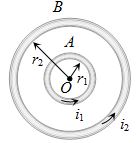
$A$ and $B$ are two concentric circular conductors of centre $O$ and carrying currents $i_1$ and $i_2$ as shown in the adjacent figure. If ratio of their radii is $1 : 2$ and ratio of the flux densities at $O$ due to $A$ and $B$  is $1 : 3,$ then the value of $i_1/i_2$  is
Electric field lines cannot forms the:
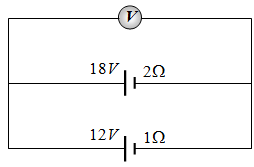
Two batteries, one of emf $18$ volts and internal resistance $2\Omega$ and the other of emf $12$ volt and internal resistance $1 \Omega,$ are connected as shown. The voltmeter $V$ will record a reading of
A block of mass M is hanging over a smooth and light pulley through a light string. T he other end of the string is pulled by a constant force F. The kinetic energy of the block increases by 20J in 1s.
  1. The tension in the string is Mg.
  2. The tension in the string is F.
  3. The work one by the tension on the block is 20J in the above 1s.
  4. The work done by the force of gravity is -20J in the above 1s.
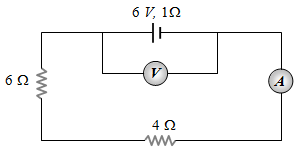
In the circuit shown here, the readings of the ammeter and voltmeter are
Complete the reaction $\mathrm{n}+{ }_{92}^{235} \mathrm{U} \rightarrow{ }_{56}^{144} \mathrm{Ba}+\cdots+3 \mathrm{n}$
The true statement is(a) The order of colours in the primary and the secondary rainbows is the same(b) The intensity of colours in the primary and the secondary rainbows is the same(c) The intensity of light in the primary rainbow is greater and the order of colours is the same than the secondary rainbow(d) The intensity of light for different colours in primary rainbow is greater and the order of colours is reverse than the secondary rainbow


An $\alpha$-particle is bombarded on $^{14}N.$ As a result, $a ^{17}O$ nucleus is formed and a particle is emitted. This particle is a:
A thin lens made of glass of refractive index $m = 1.5$ has a focal length equal to $12 \ cm$ in air.  It is now immersed in water $(\mu=\frac{4}{3}).$ Its new focal length is