Question

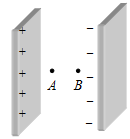
Two protons A and B are placed in space between plates of a parallel plate capacitor charged upto V volts (See fig.) Forces on protons are   and , then

(a)  

(b)  

(c)  

(d) Nothing can be said

Answer

(c)  

Need a full question paper?

Generate a complete, print-ready paper with questions like this in minutes — across 16+ boards, with answer keys.

Start Generating Free

Similar questions

The angular momentum of electrons in an atom produces:

Curie temperature is the temperature above which

(a) A paramagnetic material becomes ferromagnetic

(b) A ferromagnetic material becomes paramagnetic

(c) A paramagnetic material becomes diamagnetic

(d) A ferromagnetic material becomes diamagnetic

Nuclear forces are

(a) Short ranged attractive and charge independent

(b) Short ranged attractive and charge dependent

(c) Long ranged repulsive and charge independent

(d) Long ranged repulsive and charge dependent

A beam of light of wavelength 600 nm from a distant source falls on a single slit 1 mm wide and the resulting diffraction pattern is observed on a screen 2 m away. The distance between the first dark fringes on either side of the central bright fringe is

(a) 1.2 mm

(b) 1.2 cm

(c) 2.4 cm

(d) 2.4 mm

The average kinetic energy of the thermal neutrons is of the order of (Boltzmann's constant  

(a) 0.03 eV

(b) 3 eV

(c) 3 KeV 

(d) 3 MeV

A wire loop is rotated in a magnetic field. The frequency of change of direction of the induced e.m.f. is.

A cylindrical bar magnet is kept along the axis of a circular coil. If the magnet is rotated about its axis, then

(a)  A current will be induced in a coil

(b)  No current will be induced in a coil

(c)  Only an e.m.f. will be induced in the coil

(d)  An e.m.f. and a current both will be induced in the coil

Two waves represented by $\text{y}=\text{a}\sin(\omega\text{t}-\text{kx})$ and $\text{y}=\text{a}\cos(\omega\text{t}-\text{kx})$ are superposed. The resultant wave will have an amplitude:
  1. a
  2. $\sqrt{2}\text{a}$
  3. 2a
  4. 0.

The magnetic field at the centre of a circular coil of radius r is π  times that due to a long straight wire at a distance r from it, for equal currents. Figure here shows three cases : in all cases the circular part has radius r and straight ones are infinitely long. For same current the B field at the centre P in cases 1, 2, 3 have the ratio

(a)   :  

(b)    

(c) -  :

(d)  

The coil of the moving coil galvanometer is wound over an aluminium frame: