MCQ
Two pulses having equal and opposite displacements moving in opposite directions overlap at $t =t_1s.$ The resultant displacement of the wave at $t = t_1s$ is:
  • A
    Twice the displacement of each pulse.
  • B
    Half the displacement of each pulse.
  • Zero.
  • D
    Either $(a)$ or $(c).$

Answer

Correct option: C.
Zero.
The displacement due to two pulses will exactly cancel out each other. Thus, there will be no displacement throughout.

Need a full question paper?

Generate a complete, print-ready paper with questions like this in minutes — across 16+ boards, with answer keys.

Start Generating Free

Similar questions

The amplitude of vibration of a particle is given by ${a_m} = ({a_0})/(a{\omega ^2} - b\omega + c);$ where ${a_0},a,b$ and $c$ are positive. The condition for a single resonant frequency is
The range of a projectile fired at an angle of 15° is 50m. If it is fired with the same speed at an angle of 45°, its range will be:
A projectile is thrown with velocity $U=20\ m/s ± 5\%$ at an angle $60^o.$ If the projectile falls back on the ground at the same level then    ......... $m$ of following can not be a possible answer for range.
A uniform rope of length l lies on a table. If the coefficient of friction is $\mu $, then the maximum length ${l_1}$ of the part of this rope which can overhang from the edge of the table without sliding down is
What does not change in the field of central force
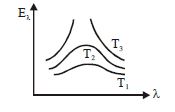
Variation of radiant energy emitted by sun, filament of tungsten lamp and welding arc as a function of its wavelength is shown in figure. Which of the following option is the correct match?
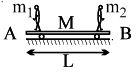
Two persons of mass $m_1$ and $m_2$ are standing at the two ends $A$ and $B $ respectively, of $a$ trolley of mass $M$ as shown. Choose the incorrect statement, if $m_1 = m_2 = m$ and both the persons jump one by one, then
The coefficient of performance of a Carnot refrigerator working between ${30^o}C$ and ${0^o}C$ is
Two stones are projected so as to reach the same distance from the point of projection on a horizontal surface. The maximum height reached by one exceeds the other by an amount equal to half the sum of the height attained by them. Then, angle of projection of the stone which attains smaller height is $........$
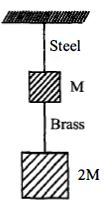
If the ratio of lengths, radii and Young's moduli of steel and brass wires in the figure are $a, b$ and $c$ respectively, then the corresponding ratio of increase in their lengths is